
Let's Read Continuous Discovery Habits Together (February 2026)
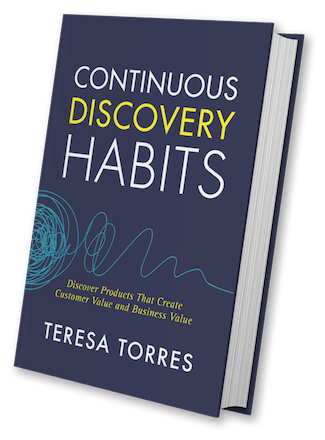
Continuous Discovery Habits turns five this year. And to celebrate we are reading the book together.
Each month, I am releasing an in-depth reading guide that includes:
- The chapters we will be reading
- A preview of the most important concepts we'll be learning about
- Short videos you can share with friends and colleagues to help spread the ideas
- Individual and team discussion questions to help you absorb and engage with the reading
- Team exercises to help you put the ideas into practice
- Additional reading to help you go deeper on the core ideas
We'll be discussing each month's reading in the comment section and we'll gather quarterly to discuss on a live call.
Joining late? No problem. I monitor the comments on each reading guide throughout the year. Start with the current month or go back to January—whatever works for you. You can ask for help, share what's working, and connect with other readers at any point.
If you want to participate, grab a copy of the book (or dig up your old copy), share the "Spread the Love" videos, reserve some time to do the team exercises, and register for the community sessions. Let's do this!
This Month's Reading
Chapters:
- Chapter 3: Focusing on Outcomes Over Outputs
Estimated reading time: ~22 minutes
This chapter will introduce you to:
- The critical difference between business outcomes and product outcomes—and why it matters which one your team is assigned
- How to translate lagging business metrics into actionable product outcomes you can actually influence
- Why setting outcomes should be a two-way negotiation between leaders and product trios
- When to start with a learning goal versus a performance goal
- Five common anti-patterns that derail outcome-focused teams
Need a copy? Grab the book.
Share the Love with Friends and Colleagues
We learn best in community. Use the following short videos to share the key concepts from this chapter with friends and colleagues. Invite them to participate in the book club with you.
- What's an outcome? - The real value of starting with an outcome
- Business outcomes vs. product outcomes - Why product teams need product outcomes, not business outcomes
- What's the difference between OKRs and outcomes? - Any outcome can be represented as an OKR
- Understanding revenue model formulas - How to identify the business outcomes your company cares about
- Revisit your outcome every quarter - Don't abandon your outcome, but do revisit how you measure it
Reflect & Discuss What You Read
When we reflect and discuss what we read, we absorb more of the material. It helps us put what we learn into practice. Don't skip this step.
This chapter challenges us to think differently about how we measure success. Most of us have been conditioned to think in terms of features delivered—not outcomes achieved. This month, focus on examining your current relationship with outcomes and where there's room to grow.
Individual Reflection
- If your team isn't working toward an outcome, look at the features or projects on your roadmap. What impact are they supposed to have? If they succeed, what customer behavior or business result would change?
- If your team does have an outcome, is it a business outcome, a product outcome, or a traction metric? How does this affect your day-to-day work?
- Think about the last time your team's outcome changed. Was it a deliberate strategic shift, or did it feel like ping-ponging from one priority to the next?
Team Discussion
- As a team, classify your current outcome: Is it a business outcome, a product outcome, or a traction metric? If it's a business outcome, what customer behaviors might be leading indicators? If it's a traction metric, how might you broaden it to a product outcome?
- Which of the five anti-patterns (pursuing too many outcomes, ping-ponging, individual outcomes, outputs as outcomes, or tunnel vision) does your team struggle with most? What's one thing you could change?
- Does your team participate in setting your own outcomes, or are they handed down from leadership? What would it take to make this more of a two-way negotiation?
Put It Into Practice
Understanding the difference between business outcomes and product outcomes is one thing. Actually translating one into the other is where the real work begins. These exercises will help you practice this translation and identify where you have the most leverage.
Exercise: Map Your Revenue Model
Time: 30 minutes
Do this: Solo first, then share with your team
Start with this question: How does your company make money? Write out the formula for your revenue model. For example, a subscription business might be: Revenue = Number of Customers × Average Monthly Spend × Retention
Once you have the formula, identify each variable as a potential business outcome. Then, for each business outcome, brainstorm two to three product outcomes (customer behaviors or sentiments) that might be leading indicators. Which of these product outcomes is your team best positioned to influence?
Exercise: Audit Your Current Outcome
Time: 45 minutes
Do this: With your product trio
Take your team's current outcome and run it through these diagnostic questions:
- Is it a business outcome, product outcome, or traction metric?
- If it's a business outcome, what product outcomes might drive it?
- If it's a traction metric, how might you broaden it to a product outcome?
- Is it a leading indicator or a lagging indicator?
- Can you measure progress weekly, or do you have to wait months?
- Is it within your team's span of control?
Based on your answers, draft a revised outcome that gives your team more actionable feedback while still connecting to business value. Prepare to discuss this with your product leader.
Go Deeper: Additional Reading
If you prefer an audio summary of this month's reading, including the book chapters and the following resources, I've included an audio version for paid subscribers at the bottom of this post.
Related In-Depth Guide
Supplementary Reading
- Empower Product Teams with Product Outcomes, Not Business Outcomes
- Defining Product Outcomes: The 8 Most Common Mistakes You Should Avoid
- Understanding How Product Outcomes Connect to Revenue and Costs
- Product in Practice: Iterating to an Actionable Outcome at tails.com
- Product in Practice: Iterating on Outcomes with Limited Data
- Measurable Outcomes - All Things Product with Teresa Torres and Petra Wille
Other Voices
- The Business Equation by Brett Bivens
- KPI Trees: How to Bridge the Gap Between Customer Behavior, Product Metrics, and Company Goals by Petra Wille and Shaun Russell
- Persistent Models vs. Point-In-Time Goals by John Cutler
- Is It Time to Ditch the Old SaaS Metrics? by Kyle Poyar
- How Engagement Metrics Can Be Misleading by Oleg Yakubenkov
- Subscription Churn Metrics and Benchmarks for Operators by Elena Verna
Related Courses
Our Live Discussion Schedule
Our live discussion sessions are for paid subscribers. Sessions are not recorded. Invitations will go out to Supporting Members and CDH Members two weeks before the scheduled event. But reserve the time on your calendar now.
- Wednesday, March 18, 2026: 9am–10am PDT and 4pm–5pm PDT
- Tuesday, June 16, 2026: 9am–10am PDT and 4pm–5pm PDT
- Thursday, September 17, 2026: 9am–10am PDT and 4pm–5pm PDT
- Wednesday, December 16, 2026: 9am–10am PST and 4pm–5pm PST
Audio Summary
This summary was produced by NotebookLM. The sources supplied were the book chapters as well as all of the additional reading.
This article is part of the CDH Book Club celebrating the five-year anniversary of Continuous Discovery Habits. See all book club posts.
Comments ()