
Ch. 7: Prioritizing Opportunities, Not Solutions
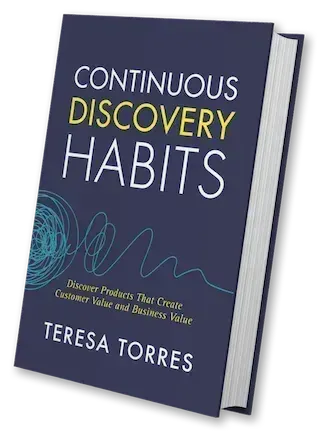
Continuous Discovery Habits turns five this year. And to celebrate we are reading the book together.
Each month, I am releasing an in-depth reading guide that includes:
- The chapters we will be reading
- A preview of the most important concepts we'll be learning about
- Short videos you can share with friends and colleagues to help spread the ideas
- Individual and team discussion questions to help you absorb and engage with the reading
- Team exercises to help you put the ideas into practice
- Additional reading to help you go deeper on the core ideas
We'll be discussing each month's reading in the comment section and we'll gather quarterly to discuss on a live call.
Joining late? No problem. I monitor the comments on each reading guide throughout the year. Start with the current month or go back to January—whatever works for you. You can ask for help, share what's working, and connect with other readers at any point.
If you want to participate, grab a copy of the book (or dig up your old copy), share the "Spread the Love" videos, reserve some time to do the team exercises, and register for the community sessions. Let's do this!
This Month's Reading
Chapter:
- Chapter 7: Prioritizing Opportunities, Not Solutions
Estimated reading time: ~16 minutes
This month's chapter will introduce you to:
- Why product strategy happens in the opportunity space, not the solution space
- How to focus on one target opportunity at a time to deliver value iteratively
- Using the tree structure to simplify prioritization decisions
- The four criteria for assessing opportunities: sizing, market factors, company factors, and customer factors
- Why treating prioritization as a messy, subjective decision leads to better outcomes than scoring formulas
- The concept of two-way door decisions and how they apply to opportunity prioritization
Need a copy? Grab the book
Share the Love with Friends and Colleagues
We learn best in community. Use the following short videos to share the key concepts from this chapter with friends and colleagues. Invite them to participate in the book club with you.
- Work on one small opportunity at a time - Reduce your batch size
- Getting started with compare and contrast decisions - Choose the right target opportunity
- Turn big intractable problems into smaller, more solvable problems - The power of decomposition
Reflect & Discuss What You Read
When we reflect and discuss what we read, we absorb more of the material. It helps us put what we learn into practice. Don't skip this step.
This chapter challenges a deeply ingrained habit: prioritizing solutions. Most product teams spend countless hours ranking features in spreadsheets, debating roadmaps, and arguing over what to build next. But this chapter makes the case that product strategy doesn't happen in the solution space—it happens in the opportunity space. The opportunities we choose to address define our competitive position far more than the features we ship.
Individual Reflection
- Think about your team's current roadmap or backlog. How much of your time is spent prioritizing features versus understanding and prioritizing customer opportunities? What would change if you flipped that ratio?
- Reflect on the last time you made a product decision. Did you treat it as a one-way door (irreversible) or a two-way door (reversible)? How did that framing affect your decision-making process and timeline?
- Consider the four assessment criteria (opportunity sizing, market factors, company factors, customer factors). Which of these does your team currently emphasize most? Which do you tend to overlook or underweight?
Team Discussion
- As a team, list the top 5-10 items on your current roadmap or backlog. For each one, try to identify the underlying customer opportunity it addresses. If you can't clearly articulate the opportunity, what does that tell you about how you're making decisions?
- The chapter argues against scoring formulas (like RICE or ICE) for prioritization, calling them "made-up math." If your team uses a scoring system, discuss: What is it really measuring? Does it help you make better decisions, or does it just make subjective decisions feel more objective?
- Walk through a recent prioritization decision. Did you assess options in isolation ("should we build this?") or compare and contrast them? How might your decision have been different with a compare-and-contrast approach?
Put It Into Practice
This month is all about shifting from solution-first to opportunity-first thinking. These exercises will help you practice prioritizing opportunities and making faster, better decisions about which customer needs to address.
Exercise: Map Your Roadmap to Opportunities
Time: 45 minutes
Do this: With your product trio
Take your current roadmap or backlog and work backwards. For each planned feature or solution:
- Identify the customer opportunity it's meant to address
- Write it as something a customer might say (e.g., "I can't find anything to watch" not "We need better search")
- Look for patterns: Are multiple solutions addressing the same opportunity? Are some solutions disconnected from any clear customer need?
This exercise often reveals that you're either:
- Spreading yourself thin across too many opportunities
- Over-investing in a single opportunity with multiple solutions
- Building solutions with no clear opportunity attached
Use these insights to inform your next prioritization conversation.
Exercise: Practice Two-Way Door Thinking
Time: 30 minutes
Do this: With your product trio
Choose 3-5 recent or upcoming product decisions. For each one, discuss:
- Is this a one-way door decision (hard to reverse) or a two-way door decision (easy to reverse)?
- If it's a two-way door, what's the smallest step we could take to learn whether we're on the right track?
- What would we need to see to know we made the wrong choice?
- If we realize we're wrong, how quickly could we course-correct?
The goal is to calibrate your team's decision-making speed. Two-way door decisions should be made quickly with "just enough" evidence. One-way door decisions deserve more deliberation and data.
Go Deeper: Additional Reading
If you prefer an audio summary of this month's reading, including the book chapters and the following resources, I've included an audio version for paid subscribers at the bottom of this post.
Related In-Depth Guides
- Opportunity Solution Trees: Visualize Your Discovery to Stay Aligned and Drive Outcomes
- Customer Interviews: Uncover Hidden Insights from Every Conversation
Supplementary Reading
- Prioritize Opportunities, Not Solutions
- 7 Key Benefits of Using Opportunity Solution Trees
- Product in Practice: How 2-Way Door Decisions Helped Simply Business Learn Fast
- Product in Practice: Getting Started with Opportunity Solution Trees at SuperAwesome
Related Courses
- Product Discovery Fundamentals: Learn a structured and sustainable approach to continuous discovery.
Our Live Discussion Schedule
Our live discussion sessions are for paid subscribers. Sessions are not recorded. Invitations will go out to Supporting Members and CDH Members two weeks before the scheduled event. But reserve the time on your calendar now.
- Tuesday, June 16, 2026: 9am-10am PDT
- Thursday, September 17, 2026: 9am-10am PDT
- Wednesday, December 16, 2026: 9am-10am PST
Audio Summary
This summary was produced by NotebookLM. The sources supplied were the book chapters as well as all of the additional reading.
This article is part of the CDH Book Club celebrating the 5-year anniversary of Continuous Discovery Habits. See all book club posts

Comments ()