
Let's Read Continuous Discovery Habits Together (March 2026)
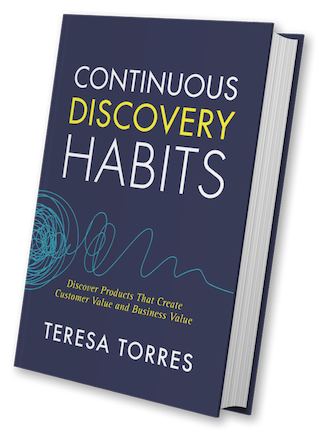
Continuous Discovery Habits turns five this year. And to celebrate we are reading the book together.
Each month, I am releasing an in-depth reading guide that includes:
- The chapters we will be reading
- A preview of the most important concepts we'll be learning about
- Short videos you can share with friends and colleagues to help spread the ideas
- Individual and team discussion questions to help you absorb and engage with the reading
- Team exercises to help you put the ideas into practice
- Additional reading to help you go deeper on the core ideas
We'll be discussing each month's reading in the comment section and we'll gather quarterly to discuss on a live call.
Joining late? No problem. I monitor the comments on each reading guide throughout the year. Start with the current month or go back to January—whatever works for you. You can ask for help, share what's working, and connect with other readers at any point.
If you want to participate, grab a copy of the book (or dig up your old copy), share the "Spread the Love" videos, reserve some time to do the team exercises, and register for the community sessions. Let's do this!
This Month's Reading
Chapters:
- Chapter 4: Visualizing What You Already Know
Estimated reading time: ~14 minutes
This chapter will introduce you to:
- Why starting individually—rather than as a group—is the fastest path to unlocking your team's collective intelligence
- How drawing (even badly) forces you to get specific in ways that words never will
- The strategic choice of setting your experience map's scope—too narrow and you miss opportunities, too broad and you lose focus
- How diverse perspectives become your team's secret weapon when you know how to synthesize them
- Why your first experience map isn't truth—it's a hypothesis you'll test and evolve with every customer conversation
Need a copy? Grab the book.
Share the Love with Friends and Colleagues
We learn best in community. Use the following short videos to share the key concepts from this chapter with friends and colleagues. Invite them to participate in the book club with you.
- Visualize your thinking - To bring others along
- Unlock team alignment - With visualizations
Reflect & Discuss What You Read
When we reflect and discuss what we read, we absorb more of the material. It helps us put what we learn into practice. Don't skip this step.
Most of us believe we work collaboratively, but we've never truly experienced what it means to build shared understanding from diverse perspectives. This chapter challenges you to get uncomfortable—to draw when you'd rather talk, to work alone before working together, and to see your maps as living documents rather than one-time deliverables.
Individual Reflection
- Think about the last time your team tried to align on what you know about your customers. Did everyone start by creating their own perspective first, or did you jump straight into a group discussion? What happened as a result?
- When was the last time you drew something at work? What stops you from using drawing as a thinking tool—is it discomfort with your drawing skills, lack of time, or something else?
- Look at your current work. If you were to create an experience map right now, what scope would you choose? How does your desired outcome help you determine what to include and what to leave out?
Team Discussion
- As a trio, each person should identify one unique perspective they bring to your team's understanding of your customer. How might these different viewpoints create blind spots if you only relied on one person's view?
- When your team disagrees about what customers need or want, how do you typically resolve it? Do you debate until someone wins, defer to the most senior person, or test your different hypotheses?
- Does your team have a current experience map? If so, when was the last time you updated it based on what you're learning from customers? If not, what's preventing you from creating one?
Put It Into Practice
Understanding why experience maps matter is different from actually creating one that drives your discovery work. These exercises will help you practice the discipline of starting individually, synthesizing diverse perspectives, and using your map to guide customer conversations.
Exercise: Create Your Individual Experience Maps
Time: 20 minutes individually, 45–60 minutes with your team
Do this: Individually first, then share with your trio
Start by agreeing on the scope of your experience map based on your current outcome. Each member of your trio should then independently create their own experience map using pen and paper (or your favorite digital drawing tool).
Focus on drawing the customer's experience, not your product's features. Where do they get stuck? What goes wrong? How do they work around problems? Don't worry about drawing well—boxes, arrows, and stick figures are perfectly fine.
Once everyone has created their individual maps, schedule time to share them with each other. As you explore each person's perspective, ask questions to understand their thinking. Pay particular attention to the differences between maps—this is where the richest insights emerge.
Exercise: Co-Create Your Shared Experience Map
Time: 30 minutes with your team
Do this: With your product trio
Bring your individual experience maps together and work to synthesize them into a single shared map. Start by identifying all the unique nodes (distinct moments, actions, or events) across all three maps. Arrange them in a comprehensive flow.
Collapse similar nodes, but be careful not to overgeneralize. Add links to show relationships and flow between nodes—including loops, error cases, and abandonment points. Finally, add context about what customers are thinking, feeling, and doing at each step.
As you work, avoid getting bogged down in endless debate. If you disagree about details, draw out the difference rather than debating it. This often reveals you already agree or helps you pinpoint exactly where your understanding differs.
Remember: This map is your current hypothesis about your customer's experience. Use it to guide your upcoming customer interviews and plan to evolve it based on what you learn.
Go Deeper: Additional Reading
If you prefer an audio summary of this month's reading, including the book chapters and the following resources, I've included an audio version for paid subscribers at the bottom of this post.
Supplementary Reading
- Why Drawing Maps Sharpens Your Thinking
- Core Concept: Collaborative Decision-Making in a Product Trio
Other Voices
- To Draw or Not to Draw: Is Traditional Sketching Still Relevant in the Digital Design Era? by Julia Ku
- Journey-Mapping Approaches: 2 Critical Decisions to Make Before You Begin by Kate Kaplan
- The Visual Language of Comic Books Can Improve Brain Health by Mary Widdicks
- Mapping Your User’s Day with the User Clock Sketch by Ben Crothers
Our Live Discussion Schedule
Our live discussion sessions are for paid subscribers. Sessions are not recorded. Invitations will go out to Supporting Members and CDH Members two weeks before the scheduled event. But reserve the time on your calendar now.
- Wednesday, March 18, 2026: 9am–10am PDT and 4pm–5pm PDT
- Tuesday, June 16, 2026: 9am–10am PDT and 4pm–5pm PDT
- Thursday, September 17, 2026: 9am–10am PDT and 4pm–5pm PDT
- Wednesday, December 16, 2026: 9am–10am PST and 4pm–5pm PST
Audio Summary
This summary was produced by NotebookLM. The sources supplied were the book chapters as well as all of the additional reading.
This article is part of the CDH Book Club celebrating the five-year anniversary of Continuous Discovery Habits. See all book club posts.
Comments ()