
Ladder of Evidence
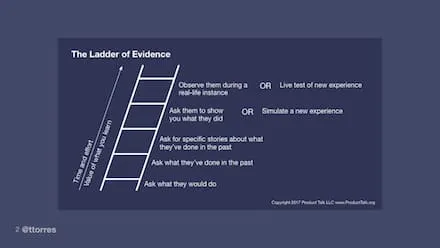
What is the ladder of evidence?
The ladder of evidence is a framework that helps product teams evaluate the reliability and value of the feedback they collect from customers and experiments. As you climb the ladder from bottom to top—from asking what people "would do" to observing what they actually do—the time and effort required increases, but so does the value and reliability of what you learn.
The framework addresses a fundamental challenge: people aren't very good at speculating about their future behavior. When asked, "Would you use this feature?" or "Would you pay for this service?" people may say yes, but that doesn't mean they actually will.
What are the three key principles of the ladder of evidence?
The ladder of evidence guides teams toward more reliable feedback through three principles:
- Avoid speculation. Don't ask what people "would do" or "might do" in the future.
- Ask for specific stories about the past to generate insights. When exploring customer needs and opportunities, ask for specific stories about what people actually did in memorable past situations.
- Look for evidence of action to evaluate solutions. When testing solutions, simulate experiences or observe real behavior rather than asking hypothetical questions.
Why does the ladder of evidence matter?
The ladder helps teams balance learning as much as possible while moving fast and continuously shipping value to customers. By understanding which research methods provide more reliable feedback, teams can make better decisions about where to invest their time and effort—avoiding building products based on what people aspire to do and instead building based on what people actually do.
Learn more:
- The Ladder of Evidence: Get More Value From Your Customer Interviews and Product Experiments
- Customer Interviews: How to Recruit, What to Ask, and How to Synthesize What You Learn
Related terms:
- Experiments
- Customer Interviews
- Assumption Testing
- Continuous Discovery
- Insight
← Back to Product Discovery Glossary
Last Updated: October 11, 2026