Exploring What's Just Now Possible: How AI-Powered Discovery and Expert Feedback Are Driving My 2026 Roadmap
2025 was full of many surprises.
Some good ones—I launched two new podcasts, I built my first AI products, I completely changed the way I work thanks to Claude Code.
And some tough ones—I'm still struggling to fully recover from a severe ankle break in March, I sunsetted our Deep Dive courses, and I've had way too many house project surprises for my liking.
As I look back on the year, a strong theme emerges. And as I look forward to this year, that theme shines even brighter. That theme is: Just Now Possible.
It's not just a podcast name, this phrase captures so much of what I'm excited about thanks to the emergence of generative AI. Yes, I know everyone is talking about AI. Yes, there is a ton of hype. And yes, we might even be in a bubble.
And I don't discount the downsides of AI. I have real concerns about the environmental impact, the impact on jobs (particularly for the young and those late in their careers), and the consolidation of power among a small set of tech companies.
But despite all of that, I'm also reinvigorated. I've rediscovered my sense of wonder and my sense of awe. I feel empowered to bring my ideas to life. For the first time in many years, I'm excited to build again. I'm excited to explore the edges of what's just now possible. And I'm excited to report back and share what I learn as I do so.
Get the product trio's guide to a structured and sustainable approach to continuous discovery.
Let's read the book together! Join the 2026 book club.
I've shared in previous letters that after my book came out, I struggled with several years of burnout. I've been doing the same thing for a very long time. And change happens slowly—much too slow for my liking. It's hard to stay focused on the end goal when you can't always see progress.
I know there has been progress. More teams are talking to customers, testing their assumptions, and visualizing their thinking. But I often only see the gaps—the leading questions, the half-baked assumption tests, the confirmation bias at play. It's both a blessing and a curse. It motivates me to keep pushing for change, but it also drags me down.
This past year has been refreshing. I can still see all those same warts, but now I can clearly see potential ways to address them. I can see how generative AI can help us create a future where discovery is easier and higher quality than ever. I can see where AI can automate some of the tedious tasks, how it can augment the most cognitively challenging tasks, and how it can even do some of the tasks that we thought were most human.
I also want to be clear. This doesn't come without risk. I fear a world where businesses replace humans with agents, where teams no longer feel a need to connect with their customers, and where numbers drive everything. I don't want to build technology that aids that future.
Instead, I want to explore a world where AI helps product teams connect with their customers, where more voices are heard, where better synthesis happens, where exploration is effortless and fun (even in large, bureaucratic organizations).
I want to bring that vision into reality. I don't have all the answers. I'm sure there will be many twists and turns. But I'm excited to continue this journey. I hope you'll come with me.
I'd like to give you a better idea of what this might look like and what I'll be doing this year to make it happen. But before we do that, let's do a brief recap of some big moments in 2025.
🎖️ This Product Talk Article is brought to you by New Year, New Habit: The 5-Day Customer Interview Challenge. Become a more confident interviewer in less than a week. You'll conduct one practice interview a day, get personalized and detailed feedback so you know exactly what to improve, and we'll be giving out daily prizes to the most improved. Join the challenge today.
🎖️ This Product Talk Article is brought to you by Just Now Possible, a podcast about how AI products come to life—straight from the builders. If you are being asked to add AI features to your roadmap, you don't have to start from scratch. Get a head start by hearing how other teams are navigating similar challenges. Find it on YouTube, Apple Podcasts, and Spotify.
A Look Back at 2025: A Year of Surprises
2025 really was full of surprises. If you had told me on January 1st that I would end the year with not one, but two podcasts, I would have replied, "No way. I'm a writer."
I am genuinely surprised that I launched two podcasts in 2025. But I'm loving both.
But here I am. I'm a co-host of All Things Product alongside Petra Wille where we discuss whatever is top of mind while you listen in. And I'm the host of Just Now Possible where I interview product builders about the AI products they are creating. And I absolutely love both of them. If you haven't listened in, be sure to explore the links.
2025 was also the year where I jumped deep into the rabbit hole that is generative AI. I had been a heavy (but unsophisticated) user starting the year. But thanks to a lot of couch time due to my injury, I started creating with AI in March and never looked back.
I launched my Interview Coach in April. I started using Claude Code in June. I launched my AI Interviewer and built the Business Fundamentals Coach in December. I released three Claude Code plug-ins in late December. And I have half a dozen other AI coaches in the works. My long-term vision is to create an AI co-pilot that helps you navigate the messy world of discovery.
We've sunsetted our Deep Dive courses. But we'll be offering the same curriculum in two new formats.
On a sadder note, I decided to sunset our Deep Dive courses. If you've been wondering why you no longer see Defining Outcomes, Continuous Interviewing, Opportunity Mapping, Identifying Hidden Assumptions, and Assumption Testing courses on our site, it's because these programs have been sunsetted.
Instead, I'll be offering these programs in a couple of new formats. I'll explain more about why as we get into my 2026 roadmap. But basically, these programs never really found product-market fit with our corporate clients and our direct-to-consumer business wasn't consistent or predictable enough to make our instructor model sustainable.
If you're an alum of one of these programs, nothing is changing for you. We are maintaining all of these courses in their current form. So if you are currently on a subscription or if you later add the CDH Membership program, you'll still get extended curriculum access to any course you've previously purchased. We are simply closing these programs to new enrollments.
Our Product Discovery Fundamentals course is not impacted by this change. It has strong product-market fit with our corporate clients and our direct-to-consumer customers, and we'll continue to offer cohorts throughout the year.
My 2026 Roadmap Full of Experiments (Not Features)
I have a number of experiments lined up for 2026 that I'm excited to share with you.
Our Product Portfolio is Evolving: On-Demand Courses & The Discovery Habits Toolbox
While we sunsetted our Deep Dive courses as cohort-based courses, the curriculum that drove these programs will live on in two different formats.
For Individuals and Teams
For our direct-to-consumer customers, we will continue to offer two tracks. Our Product Discovery Fundamentals program continues to be the best introduction to continuous discovery. For our more advanced track, we are breaking our 5 Deep Dive courses into 15 on-demand courses.
Our portfolio of on-demand courses.
By breaking the program up into smaller, more digestible courses, we've made it easier for you to pick and choose exactly what you need. We can offer each component at a lower price point, making our curriculum accessible to more people. And because they are on-demand, you can participate from anywhere in the world.
I resisted on-demand for a long time, despite many of you asking for it. We learn through deliberate practice and deliberate practice requires expert feedback. We ran all of our programs as cohort-based courses led by an expert instructor because I fundamentally value deliberate practice.
But generative AI has changed the landscape. We can now give personalized, detailed feedback to every student in a way that was previously not possible. The Interview Coach opened my eyes to what generative AI makes just now possible and I'm excited to add more AI coaches to all of our programs.
And on-demand doesn't mean you have to go it alone. All of these courses will come with Slack support where you can connect with peers and our instructor team and access to Office Hours where you can get live help, on top of the high-quality, personalized feedback from our AI coaches.
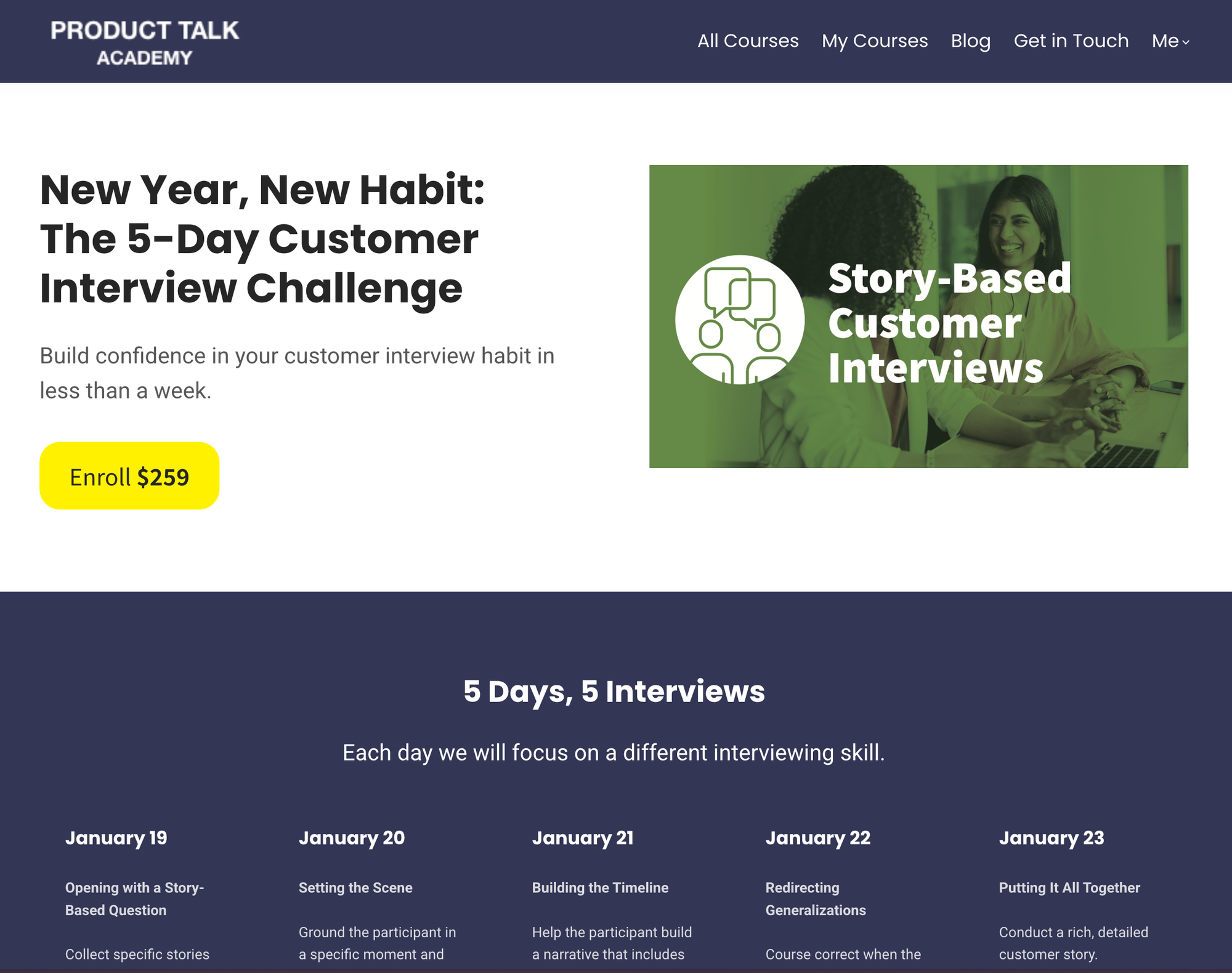
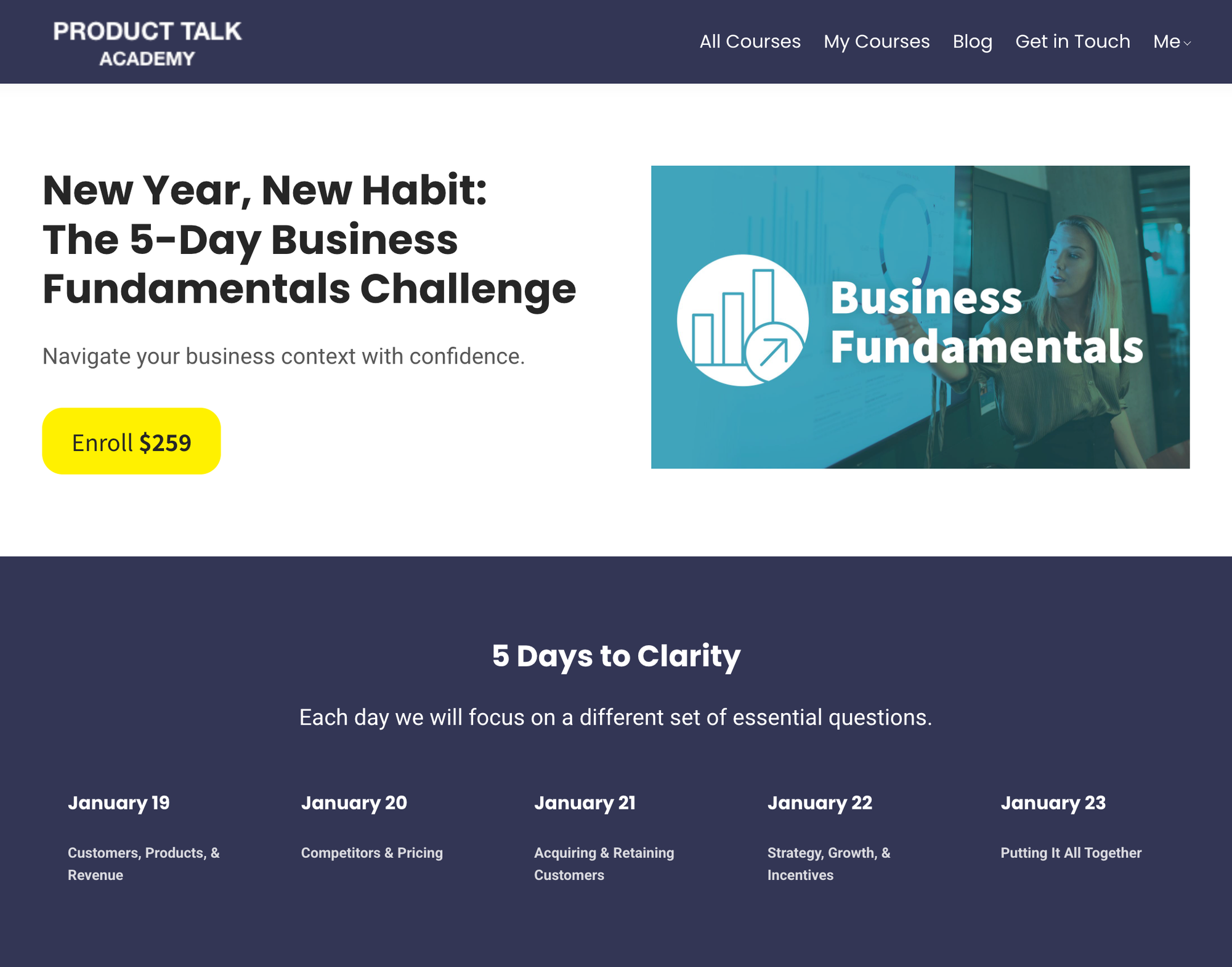
Join one of our 5-Day challenges to build skill quickly.
We'll also be hosting 5-day challenges—focused events designed to help our on-demand students work through the curriculum and build momentum. We'll track student progress on a leaderboard and give out prizes to our most improved students.
As of today, we have three on-demand courses available:
- Business Fundamentals: Navigate your business context with confidence.
- Customer Recruiting for Continuous Discovery: Get easy access to customers week over week.
- Story-Based Customer Interviews: Gain insights from every customer interview.
And we have two upcoming challenges:
- The 5-Day Customer Interview Challenge for our Story-Based Customer Interviews students: January 19–23, 2026
- The 5-Day Business Fundamentals Challenge for our Business Fundamentals students: January 19–23, 2026
As part of these challenges, we'll be raffling off Product Talk subscriptions, course coupons, one-on-one coaching sessions, and much more.
We'll be rolling out the remaining 12 courses throughout the year, as their corresponding AI tools are ready. I am very excited about what AI unlocks when it comes to providing personalized, detailed feedback on student work. It gives a whole new meaning to deliberate practice. We'll be delivering these tools via our on-demand portfolio.
If you are an individual or team looking to invest in your discovery habits, our Product Discovery Fundamentals cohorts and our On-Demand courses are your best options.
For Companies
For our corporate clients, we still recommend you start by sending your teams through Product Discovery Fundamentals. This cohort-based course is the best way to get introduced to a structured and sustainable approach to continuous discovery.
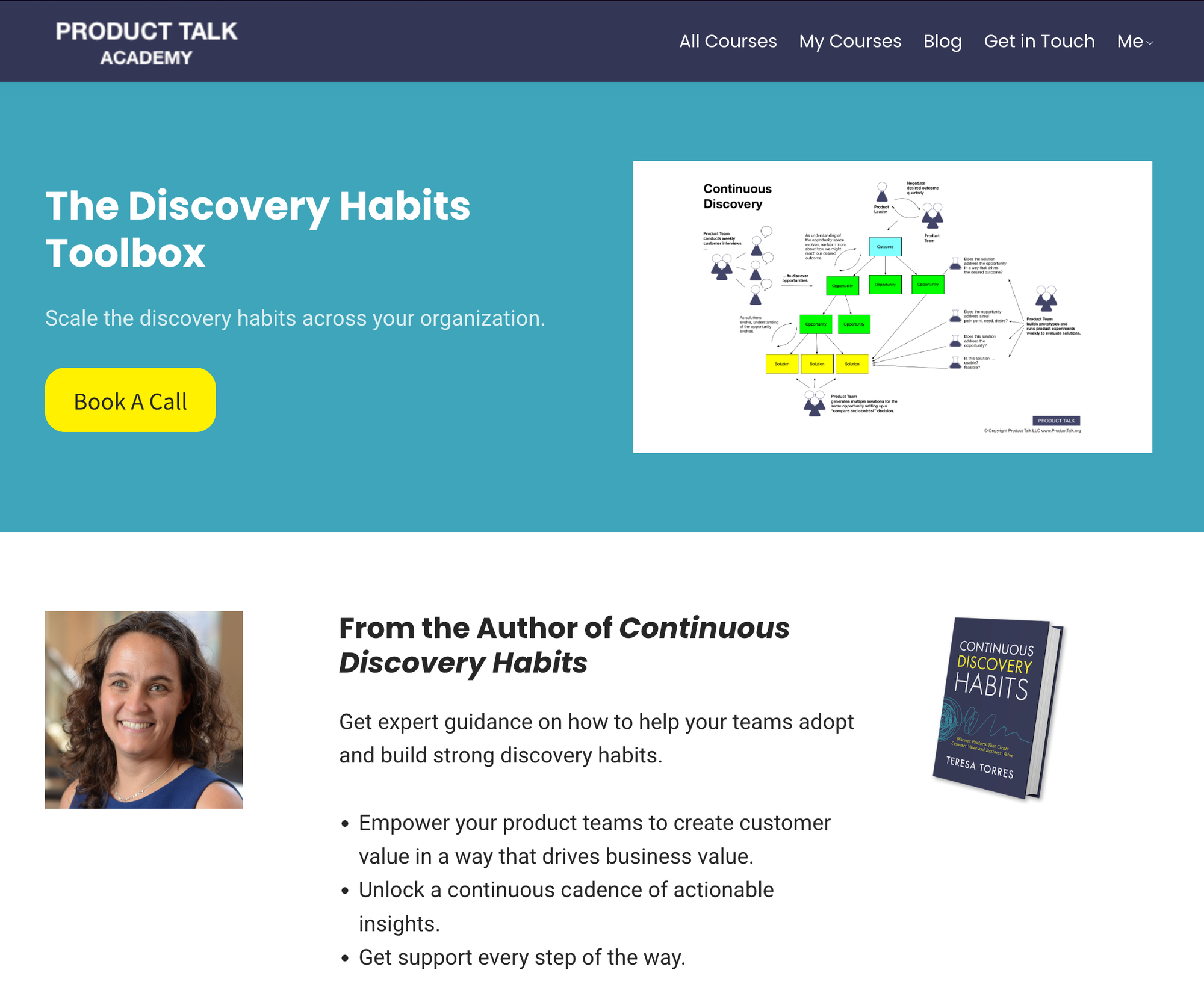
For companies that have completed our Product Discovery Fundamentals course and want to go deeper, we are rolling out The Discovery Habits Toolbox.
The Discovery Habits Toolbox is designed to solve a few common challenges that we see in organizational transformations.
- Training is not enough. We wish it was as simple as sending everyone to our classes and calling it done. But this doesn't work. Training is often necessary, but it is never sufficient.
- Leaders need to be involved in your transformation. If you want your transformation to succeed, your leaders need to lead the change. Full stop. This is non-negotiable.
- Leaders are new to the discovery habits and need support as they coach their teams. This is a real challenge. Leaders can't hold teams accountable and drive the necessary change if they don't understand, experience, and live the change themselves.
We've seen this play out in organization after organization. Companies send their teams to training, but their leaders don't participate. They don't understand the new way of working. They don't reinforce it. They can't coach it. And therefore, nothing in the organization changes.
Over the past year, I've talked with dozens of leaders who want to help their teams through the transformation, but they simply don't know how. The Discovery Habits Toolbox is designed to equip those leaders to lead the change in their organization.
It gives their teams:
- On-demand access to our most advanced curriculum
- Support through live Office Hours
- 24/7 access to our Slack community for discovery practitioners
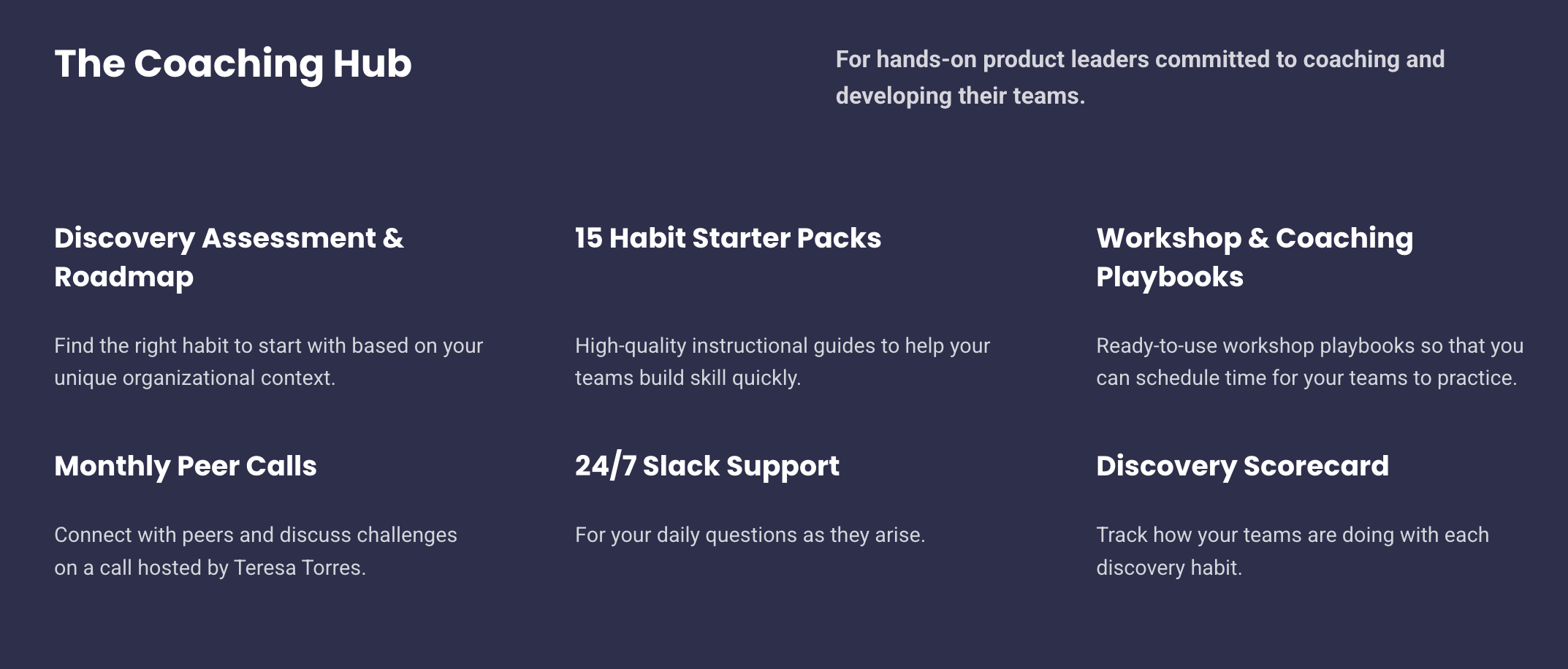
And it gives every leader in the organization:
- On-demand access to our full curriculum, so you can build your own skills before coaching your teams.
- Coaching playbooks that guide you through your team one-on-ones. We'll tell you what to look for in your team's work, what questions you can expect (with answers), and common challenges to keep an eye out for.
- Workshop playbooks so you can host internal practice sessions to help your teams build skill without bringing in expensive consultants.
- A private Slack channel and dedicated Office Hours so you can always get help from our instructor team and connect with peers.
With this program, we can now empower every leader to coach their own teams. This is just now possible thanks to the high-quality AI tools we are building. The leader doesn't have to be the expert. The leader can rely on the AI to be the subject matter expert while they focus on coaching and developing their teams.
I don't expect this program to be a panacea. It still requires that leaders embrace the change and are willing to coach their teams. But for those of you who are willing, this program should help empower you to do so.
If you are interested in the Discovery Habits Toolbox, you can learn more here.
Exploring Two Paths with AI Products: Augmenting and Automating
Back in March, when I started building with AI, I was adamant that AI should help us build skills, not do the work for us. But my views are evolving.
Part of this is due to the reality of the market. Telling teams to do discovery is like telling people they should eat broccoli. We know we should do it, but we really don't want to.
Now that there's an easy shortcut (i.e. just ask ChatGPT), many teams will turn to this shortcut, no matter how much I preach. Why would you eat your broccoli when you could just take this magical pill instead?
I can't keep you from taking the magic pill. And I know telling you to eat your broccoli won't change your behavior. So I'm going to spend some time making better magic pills.
I will continue to invest in teaching tools. I fundamentally believe that all product builders need to develop strong discovery habits. But I also recognize that many teams won't make time for this and that AI can still play a role in helping them learn about their customers.
So I'll be splitting my time between building AI teaching tools that help you learn the discovery habits and building AI tools that help you automate many of the discovery habits. My AI teaching tools will be available via our on-demand courses and through the Discovery Habits Toolbox.
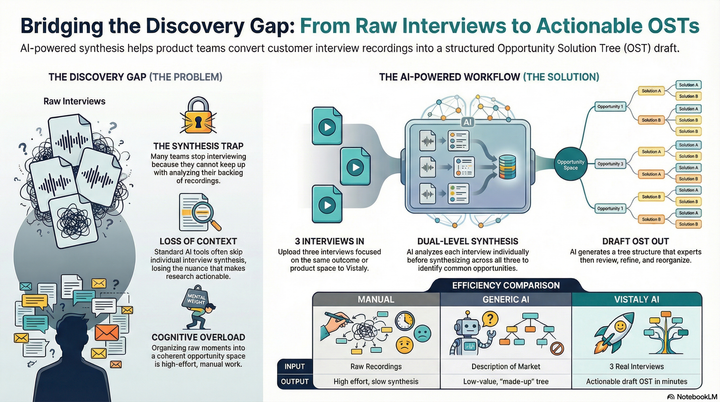
For discovery automation, I'll be expanding my partnership with Vistaly to bring you AI-powered interviews, interview snapshots, and opportunity solution trees. I'll have much more to share about this in the coming months. I'm excited that this work will raise the floor across the industry—helping more teams learn about their customers.
But know that my fundamental stance hasn't changed. When we let AI do this work for us, we are giving something up. Some of the value of the work is the actual doing of the work. And that's why I'll still teach the fundamental skills.
My hope is that expert humans will pair with and be augmented by AI agents and I'll continue to work hard to try to make that vision a reality. But I invite you to help create that vision as well. Don't just outsource your discovery work, even though it is rapidly becoming just now possible. Do both. Develop your discovery skills. Let AI do some, you do some, figure out the best balance for your team.
Experimenting with Being a Media Company: Subscriptions and Sponsored Ads
While I'm excited about generative AI, it presents a significant risk to my core business. Corporate training is rapidly changing and will probably never be the same.
Today, any product builder can ask ChatGPT to teach them how to conduct a story-based interview. ChatGPT was trained on my book and can walk you through the fundamentals. It can role-play with you and help you practice. I don't believe it's as good as the learning experiences we've designed, but many of you are choosing this option over formal training.
I get it. Budgets are tight. Calendars are full. There are only so many hours in the day. ChatGPT feels good enough.
This means I have to do more to show that my content, my curriculum, my AI feedback tools are better. This is one of the reasons why I'm shifting from higher-cost cohorts to lower-cost on-demand courses. I'll be hosting five-day challenges instead of five-week courses. I want to increase the value while simultaneously decreasing the effort required to get the benefit.
This is both scary and exciting to me. If I pull it off, I'll reach more people, have more impact, and hopefully still grow a training business. But I know better than to put all my eggs in one basket, so I'm running other experiments.
And one of them will be experimenting with one of the fastest growing creator-economy business models that has arisen over the past five years: Subscriptions and sponsored ads.
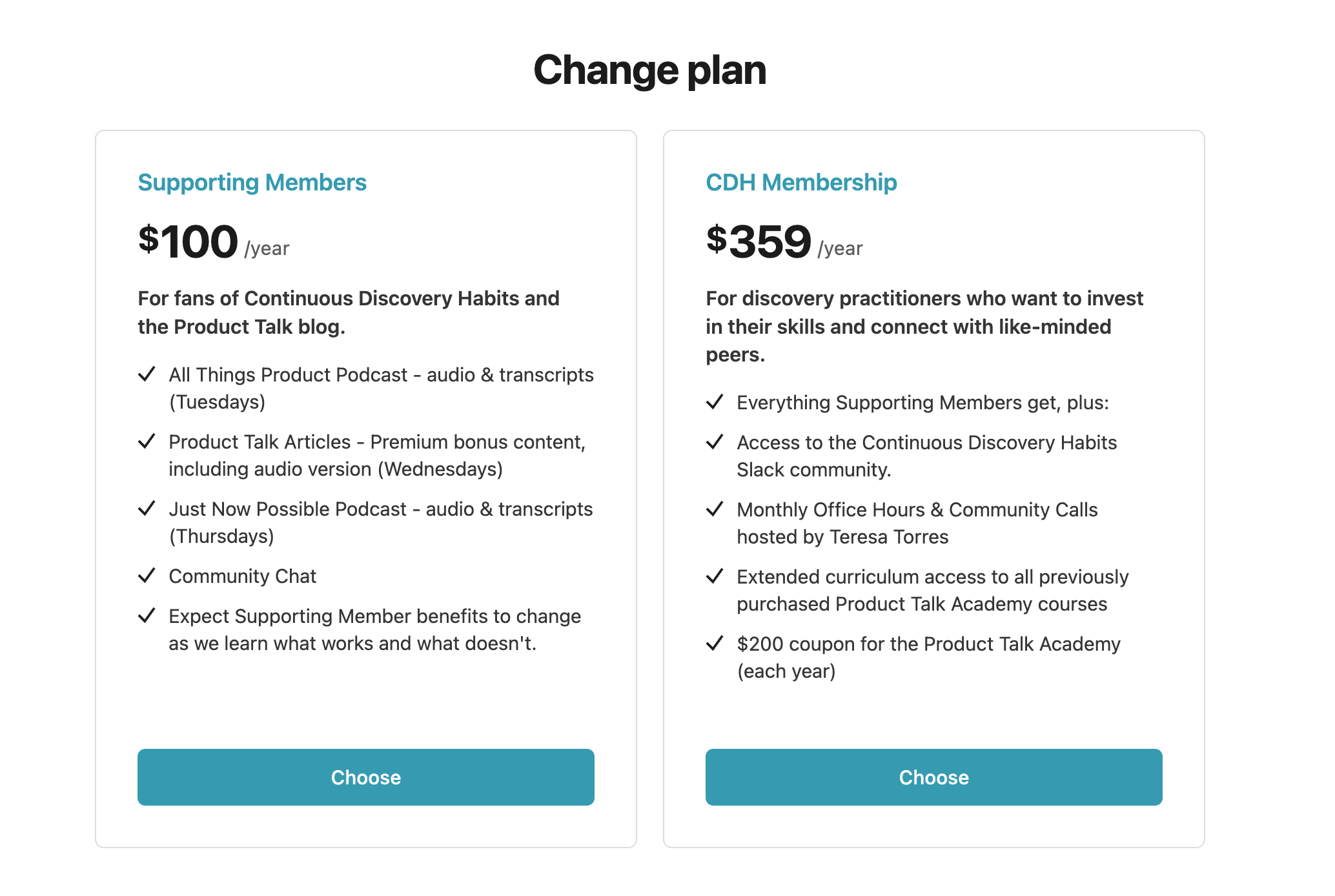
You might have noticed that we rolled out paid subscriptions this past fall. I did this because I wanted to share openly and freely about how I'm using Claude Code and other generative AI tools in my daily work. But I also need to make a living from this work. I didn't feel ready to package it into a course. It's changing too fast. So I decided to offer most of it for free and some of it for paid subscribers. I'm still trying to find the right balance and I'm open to your feedback.
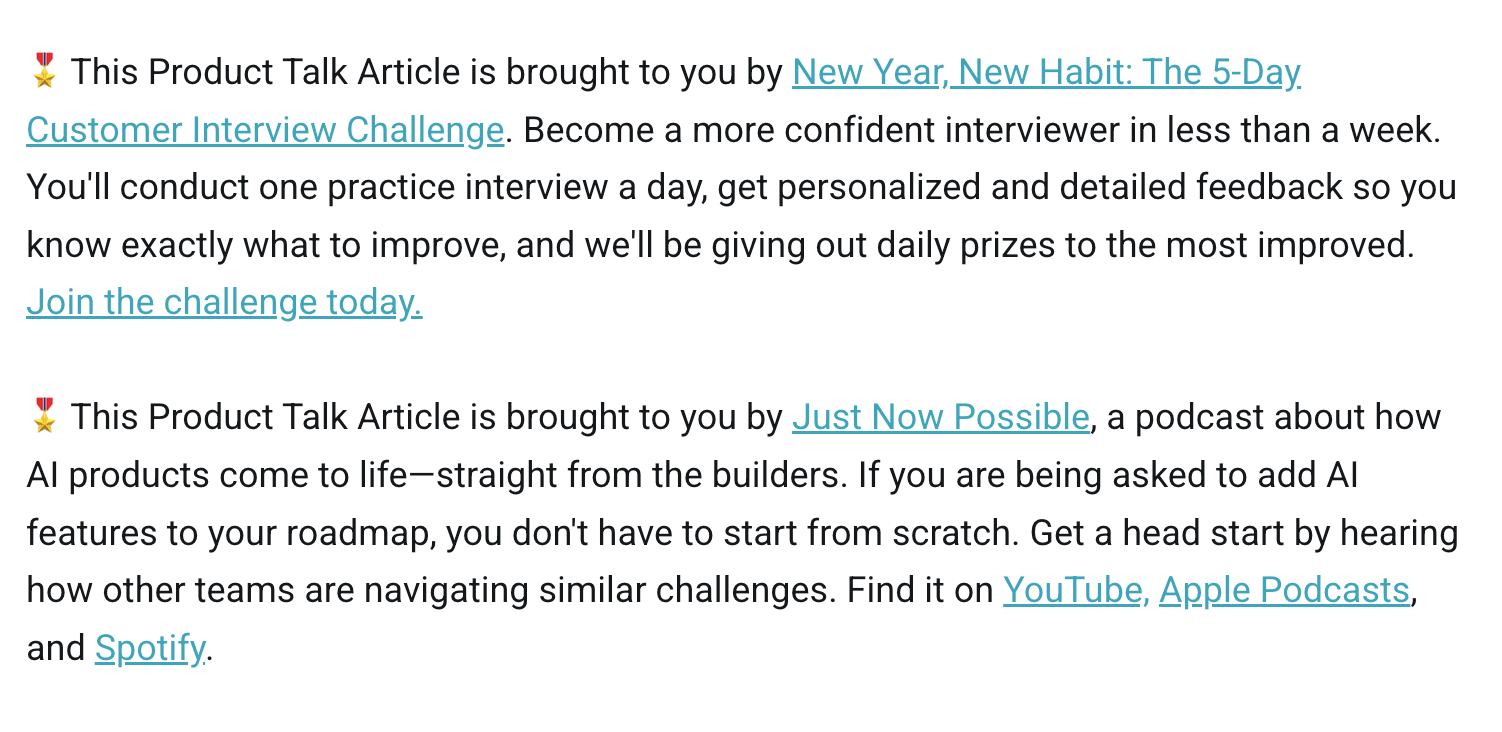
You'll also notice that in January, I started running house ads on all of our Product Talk articles and on the CDH Book Club content. I'm collecting data and testing some assumptions in preparation for rolling out sponsored ads on Product Talk.
I'm going to be honest, I don't love ads as a business model. I believe strongly in the saying, "If you aren't paying for the product, you are the product." I hate advertising. I want you to be my customer, not my product.
But I also see that it is where the market is going. Every week, I get several requests from companies who want to advertise in my newsletter. And at the same time, I see more and more of my readers unwilling to shell out even $10 for a copy of my book, let alone a subscription or a course. Too many consumers want everything to be free (or extremely low cost).
I don't know what the answers are. But I'm putting my own prejudices aside and I'm going to experiment with sponsored ads. I know this might not be welcome news to some of you. Here's what I can promise you: The ads will be relevant. They will come from ethical companies. And I will always disclose what is an ad and what is not. No advertiser will have any say in my editorial content ever. That is a non-negotiable for me.
My goal with subscriptions and sponsored ads is to be able to offer more for free and at a low price point. I want anyone who is interested in developing their discovery habits to do so.
And if you are interested and willing, I'd love your support. If you haven't already, take a minute and choose a subscription option. A subscription unlocks all of the premium content here on Product Talk, gives you access to exclusive events, and I'll be experimenting with additional member benefits throughout the year. If you can't afford it, I get it. You can still help. Please share my work with a friend or colleague who you think would benefit from it.
A Final Note on Endings
Before I wrap up this annual letter, I want to highlight something that we all know, but is often hard to practice. All products have a lifecycle. We put a ton of effort into the launch. We get excited when they are growing. We maintain them when they stabilize and eventually decline. This is the lifecycle of products. It's normal. But that doesn't mean it's easy.
It was hard for me to sunset my Deep Dive courses. Our students love them. They've helped a lot of people build strong discovery habits. I have a strong instructor team who enjoyed teaching them. I loved designing them. But they've run their course.
I'm confident the curriculum will live on in another form. I have two strong experiments in flight with on-demand courses and our Discovery Habits Toolbox. But nothing is guaranteed. That's what makes this work interesting. We have to experiment our way to success. And even then it's only fleeting. We have to do it again and again.
Every year, when I sit down to do my annual review, I force myself to look at what's not working anymore, what's no longer growing, what's on the decline, and I do my best to cut them, even before I'm ready. I wasn't ready to end my Deep Dive courses. I love them.
But I know sunsetting them was the right thing to do. It's what makes room for what's next. It's what allows me to explore what's just now possible.
How about you? What will you stop doing in 2026? What are you making room for? Let me know in the comments.
Audio Version
The audio version is only available for paid subscribers.