
The Call to Adventure
In June, I returned to Product at Heart in Hamburg, Germany. I love this event.
Arne Kittler and Petra Wille do such an amazing job of curating a thoughtful lineup of speakers and they obsess over the attendee experience. If you are looking for a high-quality product conference, I recommend putting this one on your calendar.
I hosted a full-day AI Maker Studio and also was a keynote speaker. I really struggled to identify an appropriate topic given all that is happening in the world right now.
I'm tired of talking about discovery. I don't want to add to the AI guru noise. So I decided to simply share my personal story. As many of you already know, the last year has been incredibly transformational for me. My work today looks nothing like it did in early 2025. If you are interested in learning more about my story, you can watch the video or read the transcript below.
Full Transcript
Lightly edited for clarity.
Today, my job looks radically different than it did a year ago. I'm going to tell you my story. I'm not telling you the story so that you do the same thing. I don't want that to be the takeaway from the message.
I'm going to tell you my story because I think it's an amazing story of continuous improvement, of how teeny-tiny steps compound over time.
When I started to put this talk together, I looked back over my last 15 months, and I was absolutely floored by how far I've come. And my starting point was a complete, total beginner.
So I want you to think about, as I share my story, where are you today? What are you willing to be a beginner about? And how can you take a teeny-tiny first step?
We're going to go back in time. Not very far. The story begins 15 months ago in March of 2025.
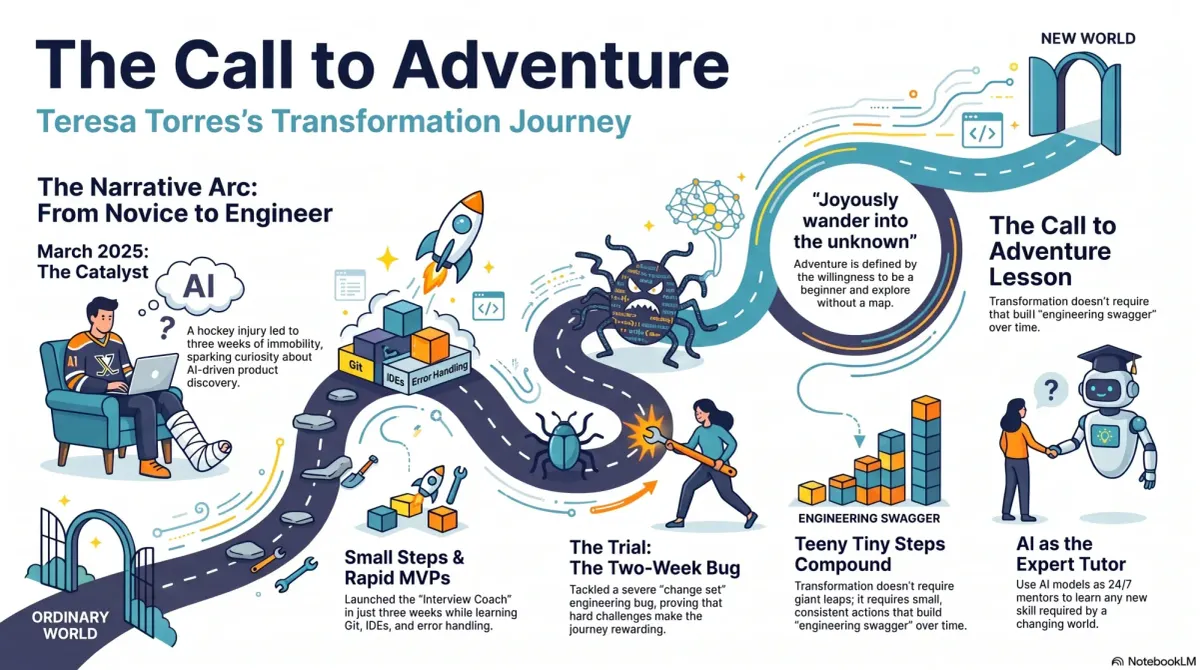
I actually had a very unfortunate injury. I broke my ankle in a hockey game. I had to have surgery. I spent three weeks on the couch on opiates, which scares the crap out of me, to be honest. I literally counted the minutes until I could take my next pain medicine.
It's the first time in 15 years I did not think about my business for 3 weeks in a row. I was physically unable to.
It was the best thing that could have ever happened to me.
Because the day after I stopped taking narcotics for my pain, I sat on the couch for the next three months and I started an amazing journey.
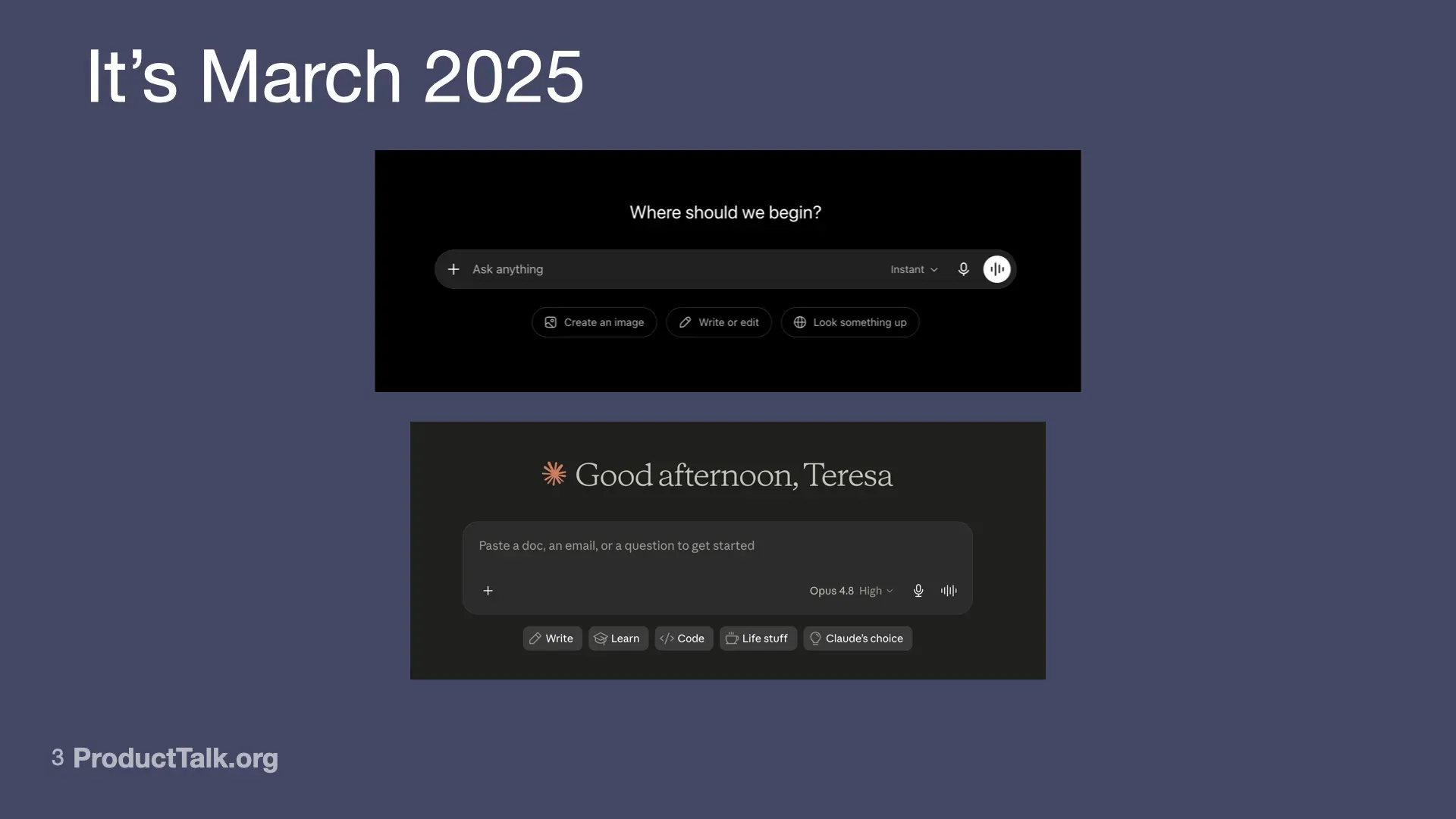
At that time, I was using ChatGPT like a lot of you, but I was using it as Google. I was asking it questions. I was avoiding ads.
It was helping me answer my questions, but I was a novice. I was not an expert in AI. I think I had tried Claude once. That's it.
This is 15 months ago. I was a total beginner.
Here's what was happening: I was literally immobile on my couch with my laptop, and every day I would open LinkedIn.
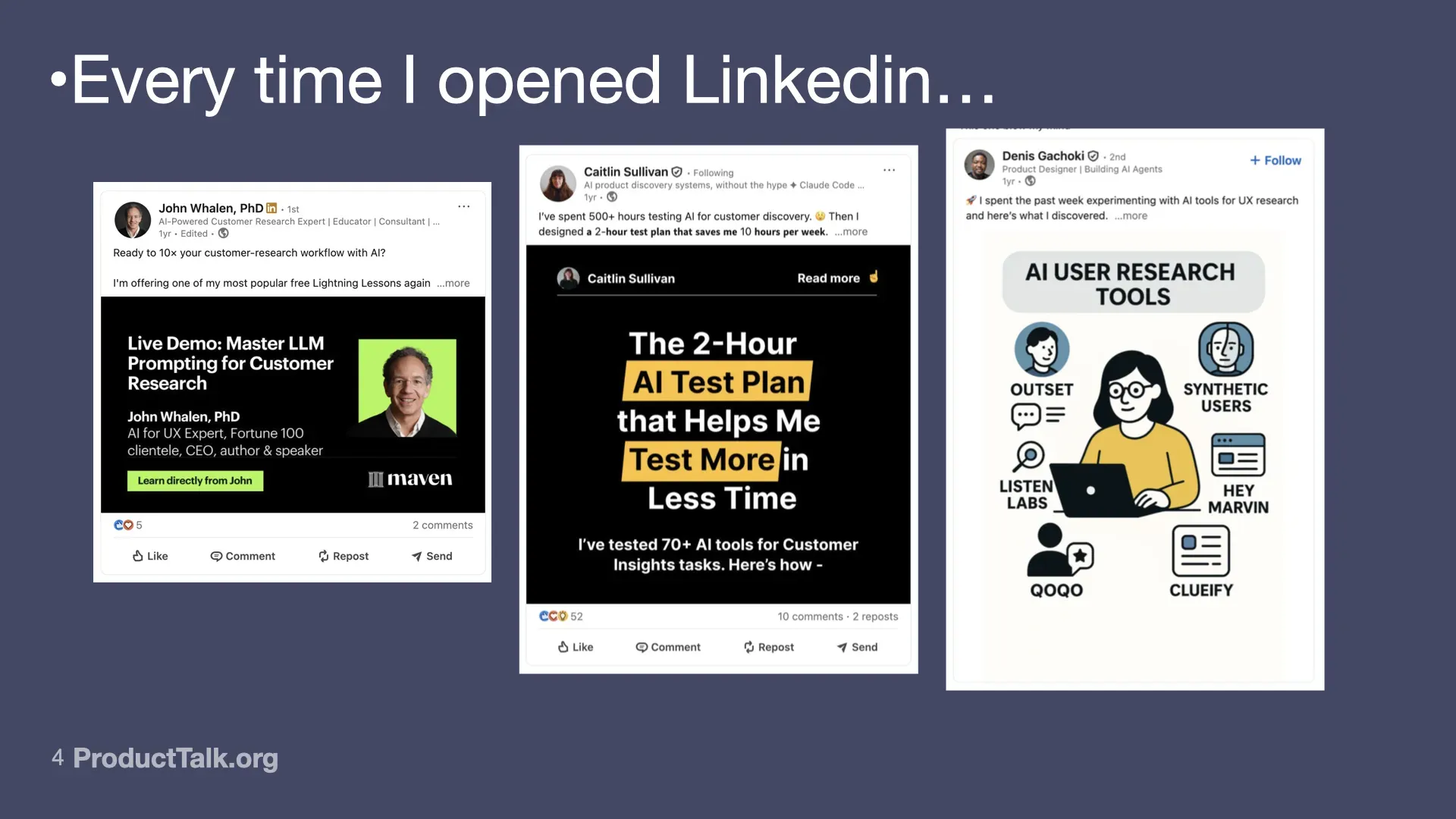
And here's what I saw: I saw this guy, John Whalen, talking about AI and discovery. I had never heard of John Whalen.
And I saw this, and I was like, huh, he's using AI in discovery. Should I be using AI in discovery?
Then I saw Caitlin, 500 plus hours running experiments with AI and discovery.
Wow, this scared me. I saw this post. I had never heard of a single one of these tools.
Now here's the deal. I was very comfortable—not literally comfortable, I was in pain on the couch—but I was very comfortable in my world. I was training hundreds of product teams.
The way this community has embraced my book has completely floored me and has been amazing.
I could have stayed comfortable. I could have said, you know what? The most important thing for you to do: Talk to your customers. That is still true today. If you are building a product for humans, the most important thing you can do is talk to those humans. That has not changed.
And I had a million reasons why AI does not change discovery. We've got to talk to humans. We're building products for humans. Talk to humans.
I know everybody had perfect prompts for synthesis.
Do you know what happens when humans do the synthesis? Magic. We learn. We go deep. We build empathy. We see what's not said, which is just as important as what's said.
I'm not joking. A million reasons. I was very cynical. I didn't want to believe that AI would change anything.
But every time I went to LinkedIn, I saw these trailblazers. I started to feel like I was being left behind.
And I'm going to be totally honest with you, I was scared. I could see right in front of me my life's work being left behind.
And if there's anything I believe in in this world, it's that if we want to build good products, we have to get really good at product discovery.
But here's the thing: product discovery is changing. Was I going to change with it?
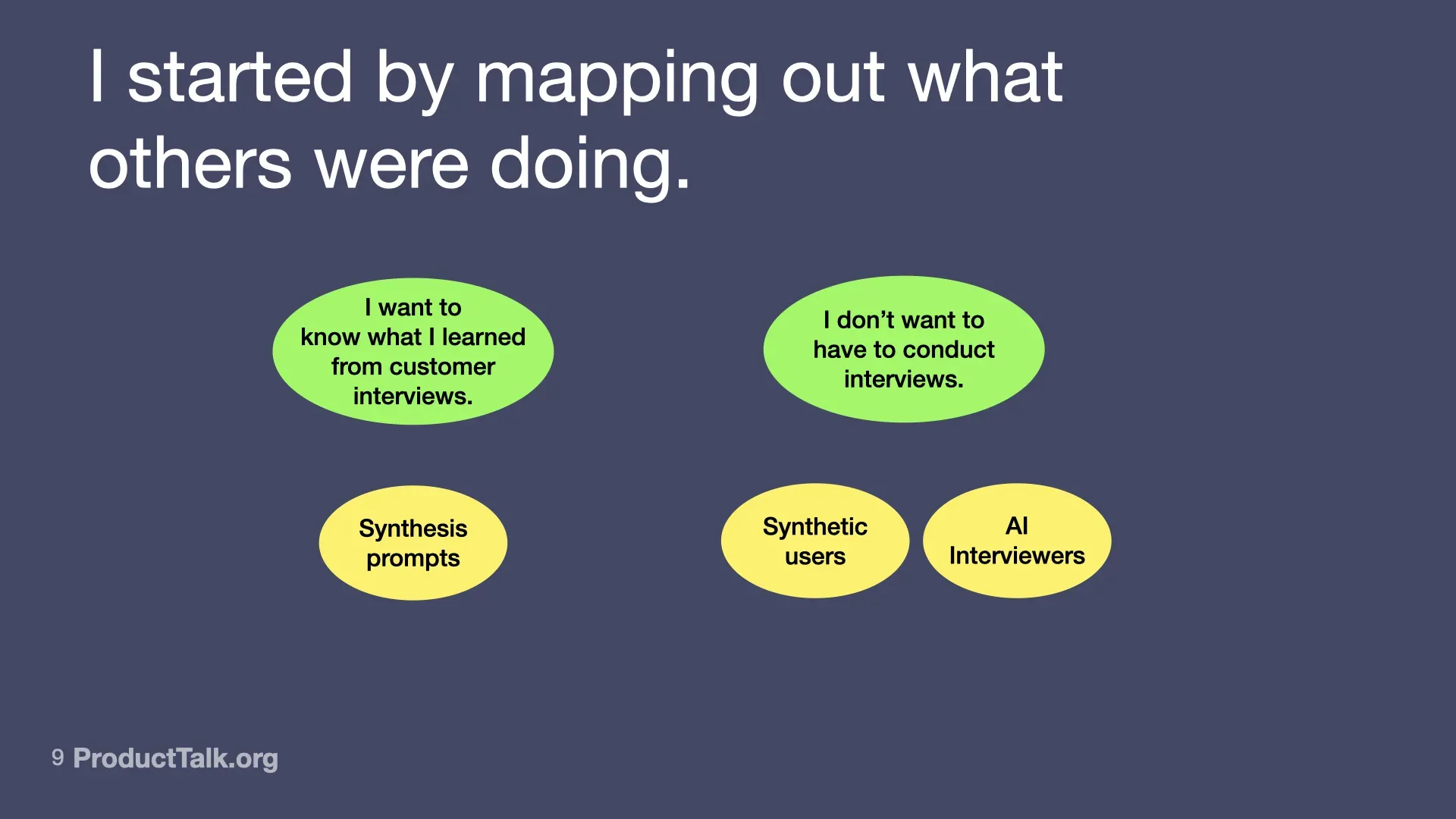
So when I get scared, I tend to get curious. And so that's what I did. I started to map out what are people doing in this space with AI.
And I saw two camps. The first camp, everybody had their favorite prompts for how to get AI to tell you what you learned from your interview. The second camp, "I don't really want to do interviews, how do I avoid them?"
Okay, I don't really love this second camp. I'm sorry, I'm not going to stand here and tell you you don't have to talk to your customers anymore. You do, right?
I got into a few arguments on LinkedIn with Hugo, the founder of Synthetic Users. He likes to argue with people about synthetic users.
And I very quickly realized that was a mistake. I don't want to argue about how you should use AI or not use AI.
I'm really sick of telling you to talk to your customers. If you haven't heard that message, there is nothing I can say to you that's going to change your mind. So I'm retiring from telling you that. It's the last time I'm going to tell you that.
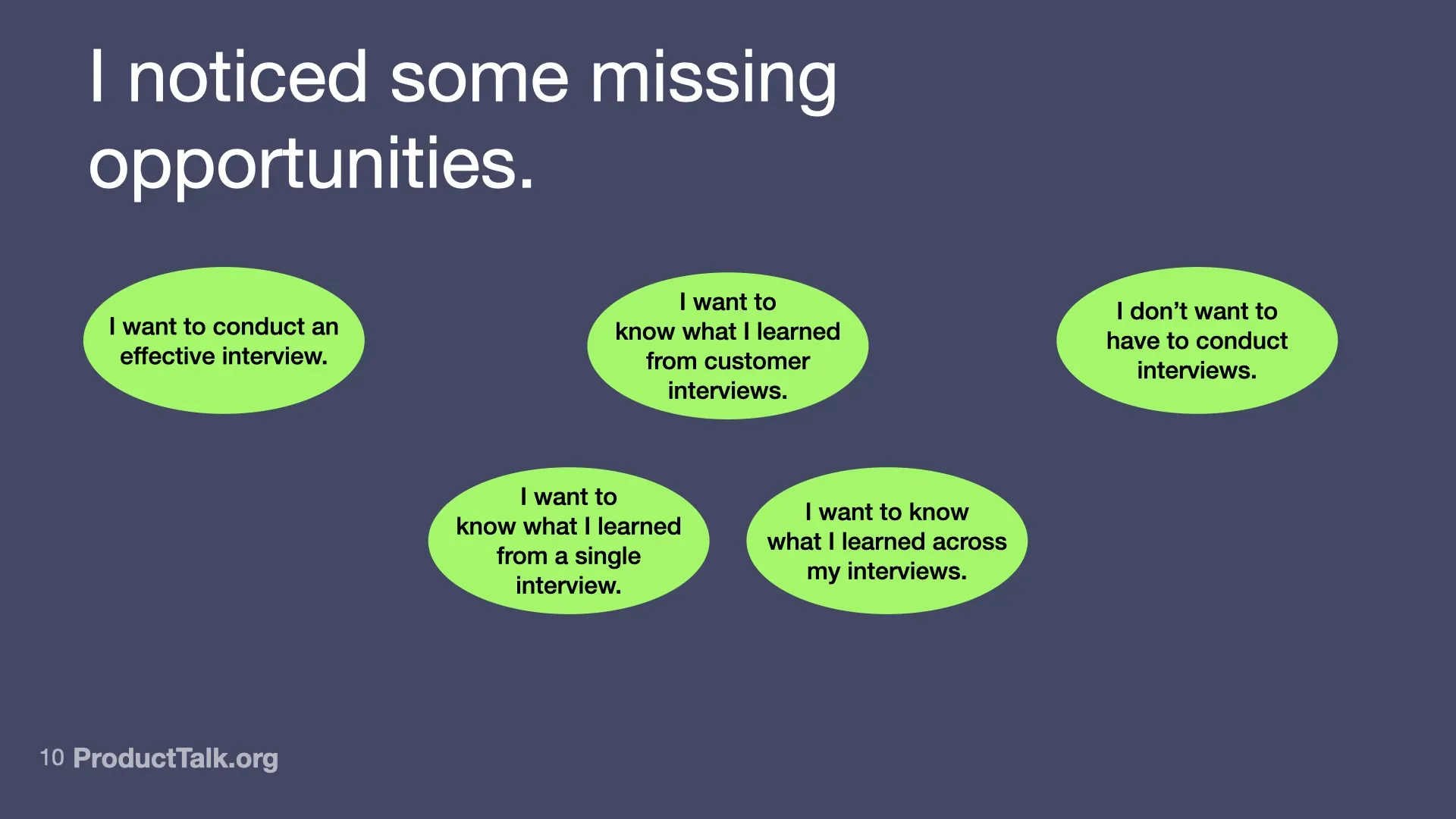
I decided to look at different problems. I looked at this and I said, there are opportunities missing. And the reason why I saw these opportunities—I have been teaching how to conduct effective interviews for nine years.
I launched my continuous interviewing course in 2017. I was coaching teams on this for many years before that and here's what I saw: We are getting better at talking to customers on a regular basis. We are not getting better at how we talk to customers. We still have a long way to go.
And I can help you with "Here's a magical prompt that the AI will tell you what you learned in your interview," but if your interview is garbage, AI will not fix your problem.
So that week, literally day one, I chose to work on a different problem. I wanted to look at how do I help you conduct a more effective customer interview? Because if it's garbage into the AI for synthesis, it's garbage out. How do we get better quality interviews?
And maybe eventually AI can help us with synthesis. We'll talk about that in a minute.
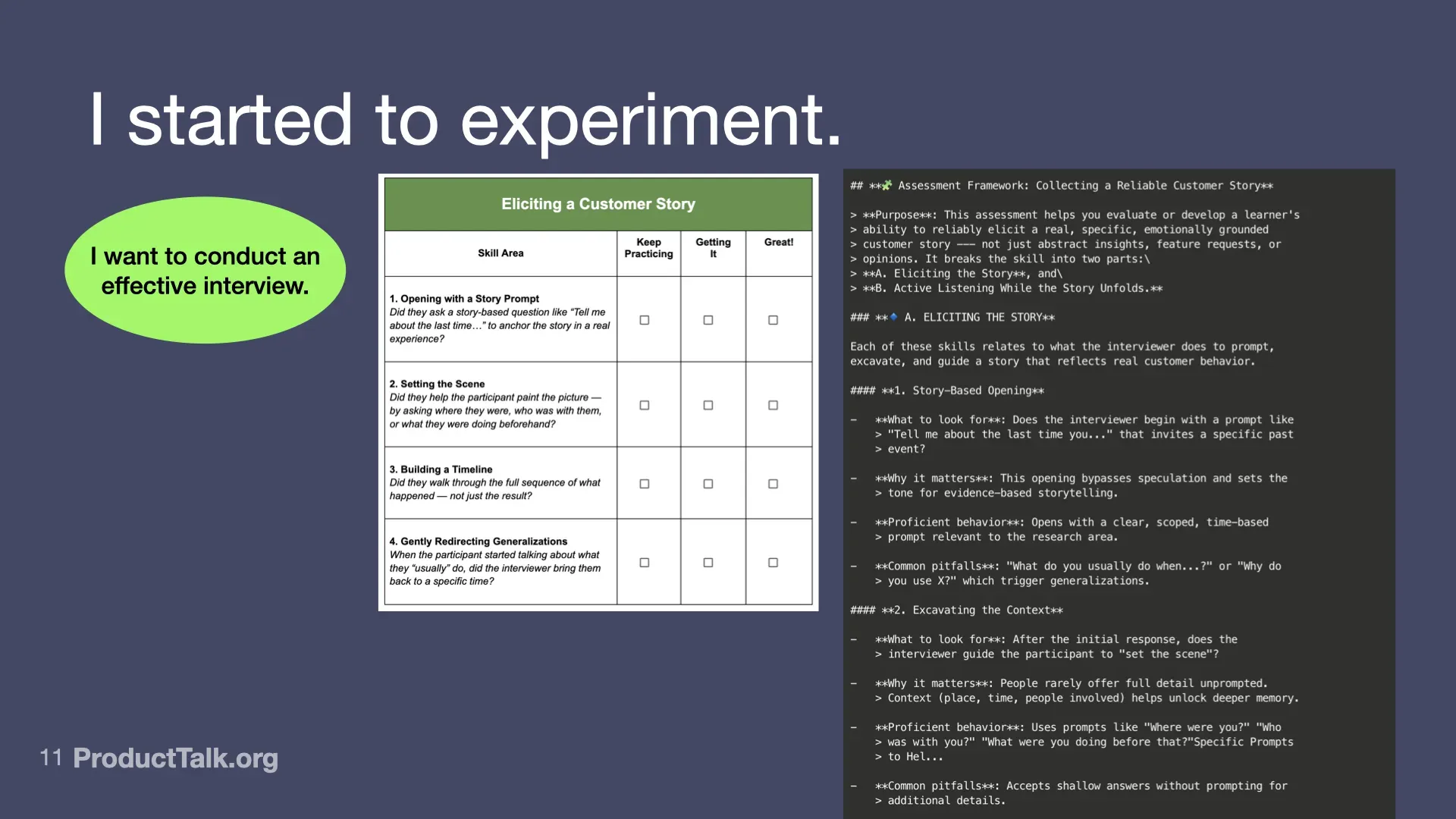
So I started to experiment. I started with this idea of, how do I help you conduct a more effective interview? Now here's the deal, I had nine years of experience with this opportunity. I've been teaching this for a very long time.
If you know my work, I'm a very structured thinker. My course is not like, "Let's talk about interviews." I actually have a very structured rubric for how we teach interviewing. We teach story-based interviewing.
A story has a narrative, it has a beginning, it starts with a story-based question. We set the scene to help the participant remember their story. And then we build a timeline. We collect the story over the arc of the story. And of course, participants want to deviate from their story. They want to start to generalize. And so we teach people to redirect generalizations.
And I was curious. In our course, we have students give each other feedback on their interviews. They're not very good at it. They're novices. They're still learning to interview.
And so our instructors have to give a lot of feedback. And I was wondering, could we model good feedback? And this led to, can AI give good feedback?
And I took this rubric that we teach in our course and I turned it into a prompt. And I was just curious, can I teach AI how to evaluate an interview?
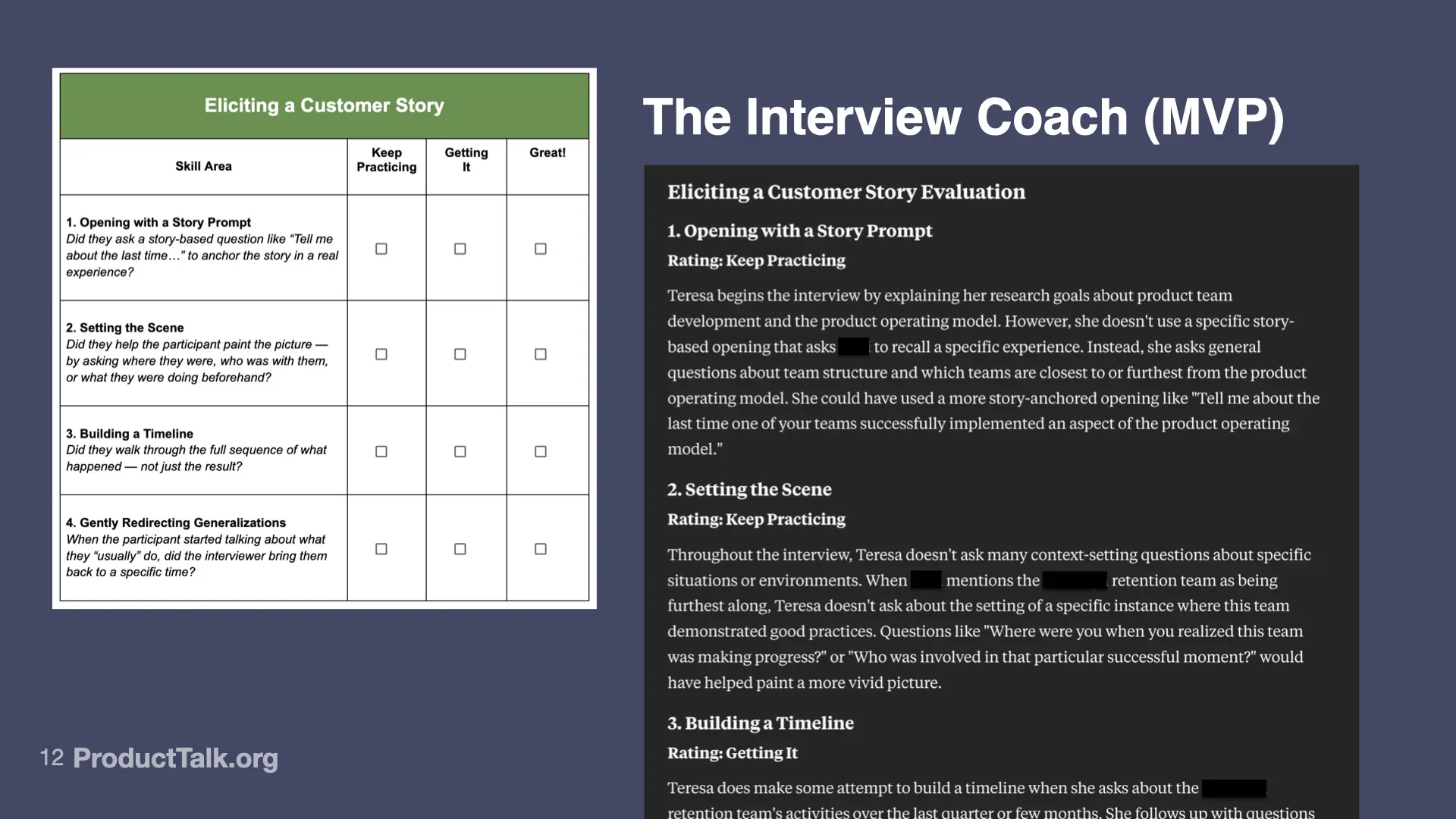
Some of you know part of this story because I've been writing about it as I've been going through it. I built an MVP, it's called the Interview Coach. We use this in our Story-Based Customer Interview course, which is our current iteration of our interviewing curriculum.
I was surprised by how good AI was at this. And this really opened my eyes. Like, okay, if AI can do this, what else can it do?
I want to remind you, on day one, I was barely using ChatGPT. It was just Google to me. I did not know how to build AI products. I knew how to write a prompt. I started with a rubric. I turned it into a prompt. I got pretty good results.
But here's the problem. The prompt is not a product. How do I get this in my course? How do I get students access to it?
I had to start learning. How do I deploy this as software? I launched the Interview Coach in my April 16th cohort, three weeks after I started experimenting. Live production product. I had no idea how to do that three weeks prior.
This snowballed. I was talking to this company Vistaly. Their founder, Matt, has been part of my Product Talk Community for many years. They build opportunity solution tree software. Some of you might know them.
And he said, "Teresa, what would it look like to bring the Interview Coach into our product?" And I said, "I don't know. Can you teach me how to be an engineer? Because I don't know how to build a production product."
And we started to talk about that. And he's like, "We're good at engineering. We can help you." And so what did I have to do? I had to learn how to do proper error handling. I had never done that before. I had to learn how to work in an IDE. I had never done that before. I had to learn how to use Git and version control. I had never done that before.
Some people read my writing today and they say, well, Teresa's different. She's an engineer. I was not an engineer. I did not know how to do any of this.
Literally one thing, a little tiny experiment that happened to turn out well that I was able to roll out in my course turned into an invitation to integrate it into a real product.
I had people that were willing to help me learn what I needed to learn to turn it into a real product. But here's the deal. I was on day one. I was a novice. I don't know how to build AI products. And I had a nagging question: Is my AI coach any good?
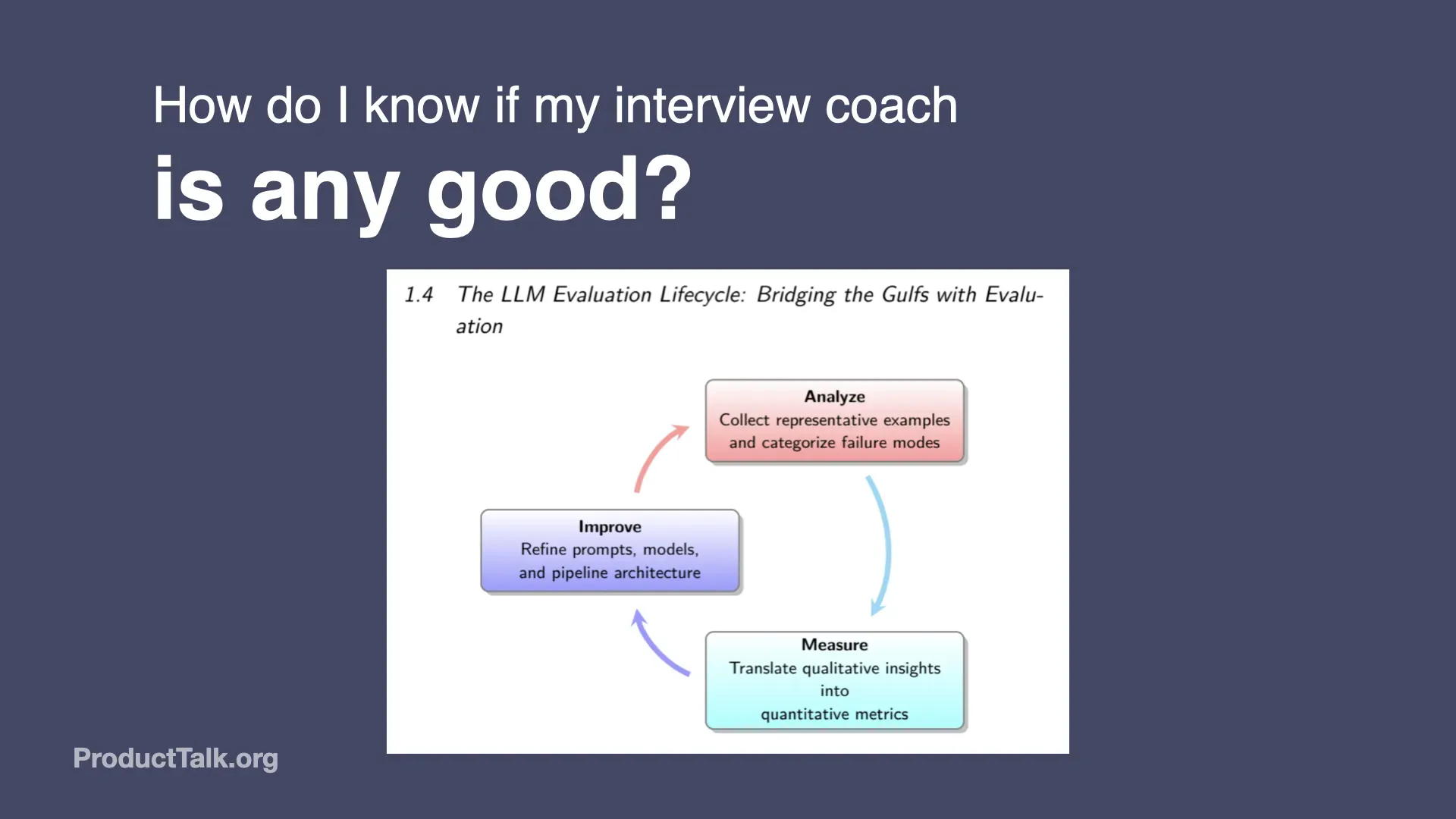
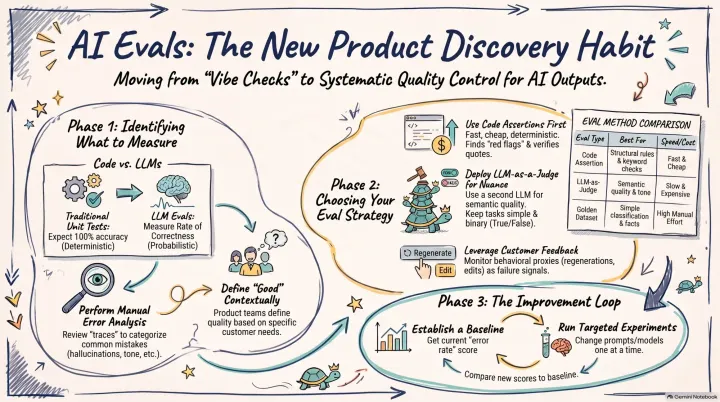
Now, for any of you that's read anything about AI products, the way we evaluate if our products are good is with evals.
I got very lucky early in my journey. I stumbled upon Shreya and Hamel's course on AI evals. I strongly recommend it.
What this course does is it teaches you that AI evals are a feedback loop. You start by looking at what your AI does wrong. You figure out how to measure those errors, and then you try to improve those errors.
Evals are a feedback loop. They are the missing discovery habit. We have a new discovery habit we have to learn if we're going to build AI products. It's AI evals.
I took to this like a fish to water. I loved it. It immediately helped me level up. The Interview Coach got better and better.
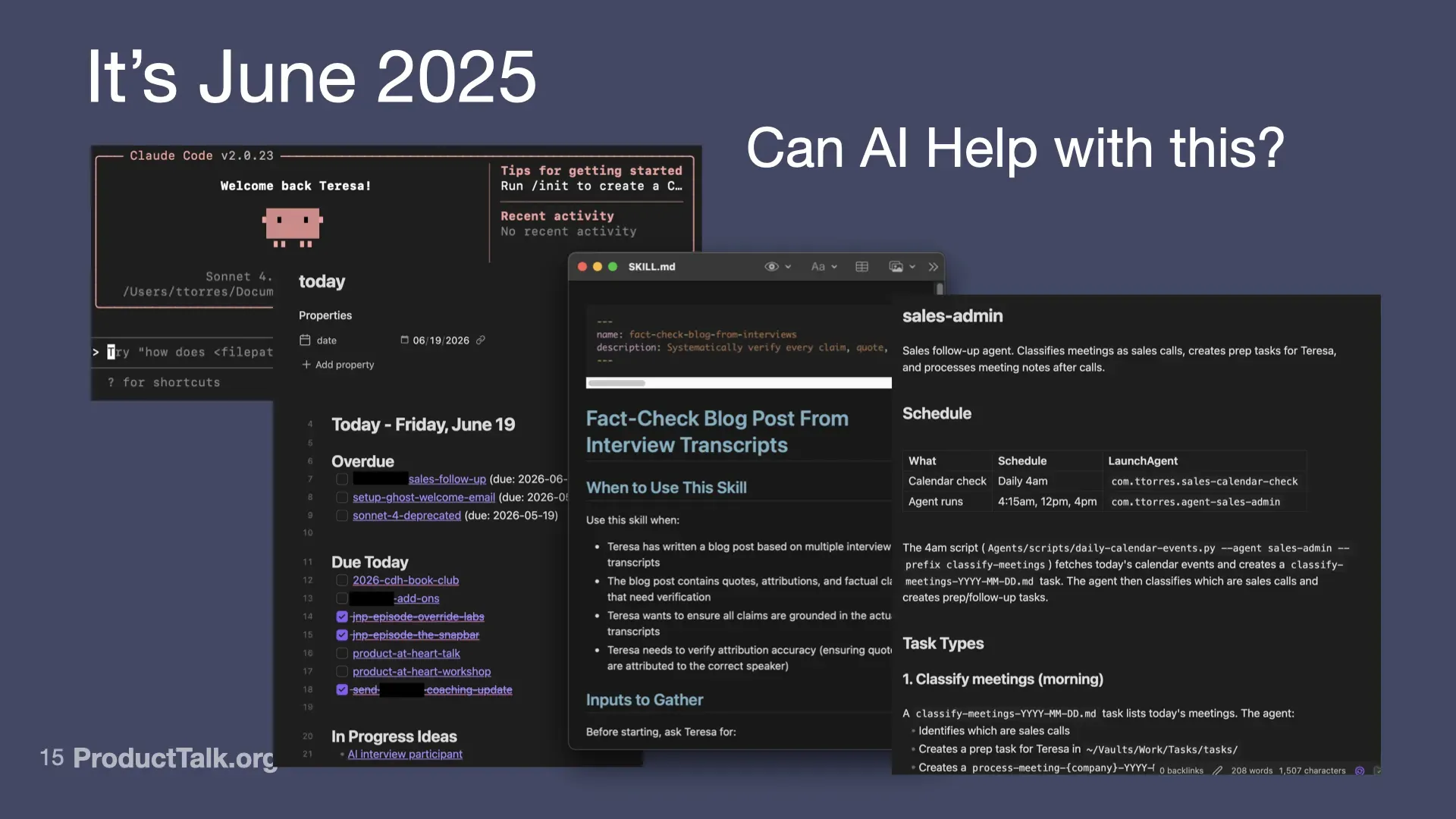
Now we're going to fast-forward to June 2025. I'm three months into my journey. I hear about Claude Code. This sounded like a tool for engineers. I can't even remember to this day why I downloaded it or tried it, but I did.
And I started asking myself a different question. Every day as I did my work, I started to ask, "Can AI help with this?" I just got curious, what else can I do with this new technology?
I built—people think I'm insane—but I built my own task management system using Claude. I was frustrated with Trello. I decided I wanted all of my tasks in markdown. I asked Claude how to do it. We started to iterate.
I use this system to this day. It was one of the best decisions that I made because it made all of my work visible to Claude, which allowed me to ask even better questions of how can Claude help me. I say Claude—I'm not sponsored by Anthropic. Some people think I am. I am not. It's just my tool of choice. Feel free to fill in whatever your favorite model or tool of choice is.
This led to me continuing to experiment. How can AI help? I started to do things like using it to support my writing. I use a fact-checker agent. I use a headline agent. I use an SEO agent.
I don't love those things. I love teaching. I want to focus on my content. I want to focus on helping teams do product discovery.
I'm going to let the agents do the things I don't want to do. I continued to keep going.
Today I have a team of about six agents that do most of my administrative work. They're all named Claude.
I've blogged about this system. What was magical about this—I didn't realize it in the moment, I was just trying things. But playing with personal productivity with tools like Claude Code taught me the skills I needed to learn to become an AI creator, to become an AI builder, to become an AI engineer.
Because I learned things like context management. Yes, I learned things about prompting. I learned things about using the file system for memory. I learned how to build in good feedback loops.
These are all the same things you need to learn when you're building production AI products. And if you're not doing that yet today—if you're not building AI products yet—I promise you it is right around the corner.
And what's nice about this, this was a really safe playground for me. It doesn't affect customers. It only affects me. It allowed me to play. It allowed me to experiment.
Let's fast-forward to September 2025. I am AI pilled. I'm all in. I jumped down the rabbit hole. Let's do this. I'm all about continuous learning.
I started to ask, how can I learn faster? I'm learning this on my own. Who can I learn from? I decided to launch a podcast. As a shout-out to Marty Cagan, it's called Just Now Possible. (Marty coined this term in this blog post.)
If there's a better name for this moment right now, I don't know what it is. On this podcast, I interview product teams about the AI products that they're building. I selfishly started this podcast because I wanted to learn from them how to build my own AI products.
It is one of the most fun things I've ever done. I get to nerd out with people about what they're building. And this is my emphasis: I'm not interviewing executives. I'm not interviewing people at giant name companies. I'm talking to people that right now are on the ground learning how to build AI products.
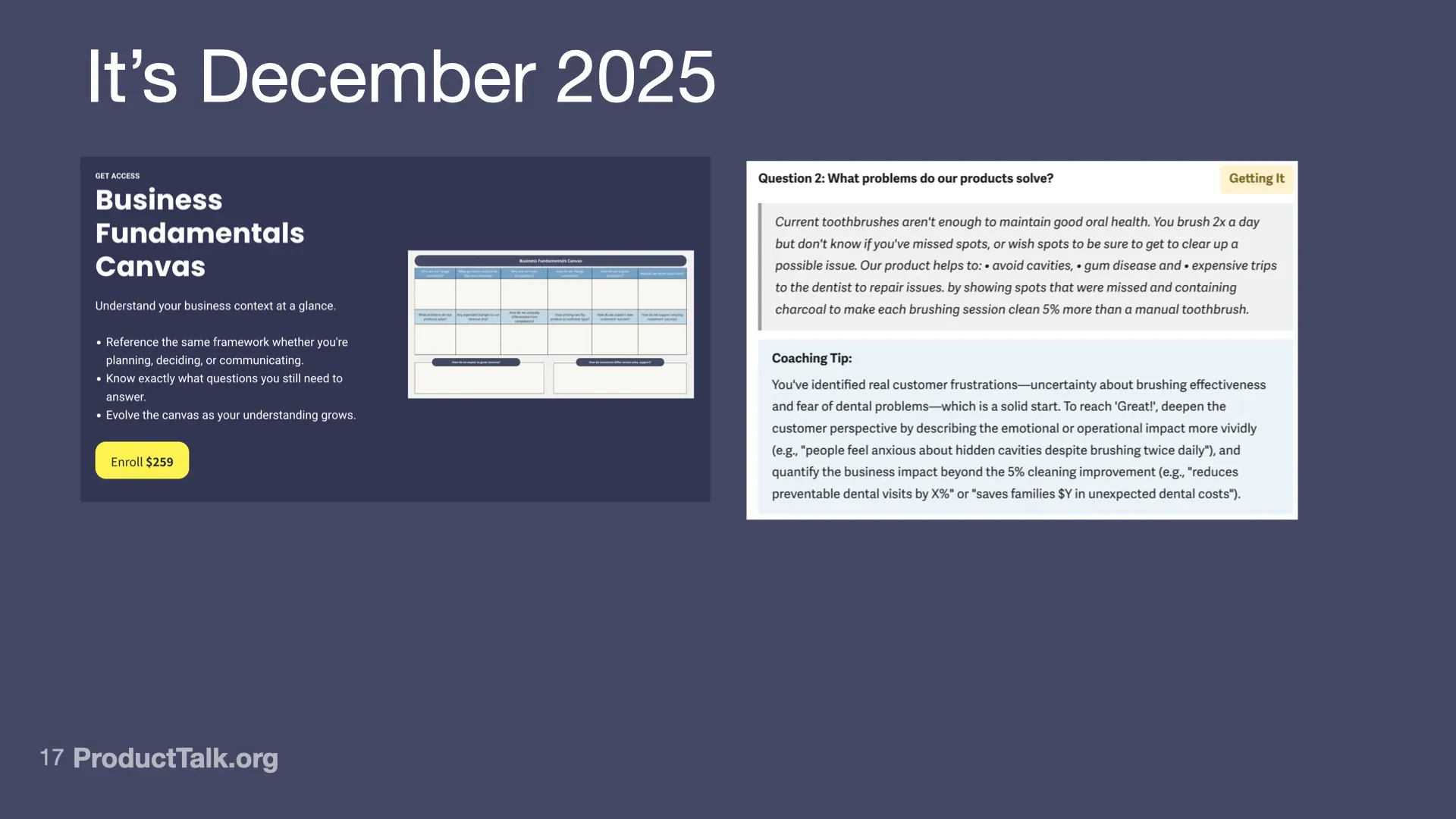
It's now December 2025. I'm working on a new course with my partner Hope Gurion called Business Fundamentals. We're trying to teach people about their strategic context, about the business context, how to speak the language of business. As Christian just said, how to understand business outcomes, how to speak our executives' language.
And I start to wonder—I've already built an Interview Coach. I wonder if I can build a new AI coach for this course.
Two weeks later I launched our Business Fundamentals Coach. Every single student in this class submits their homework. They get personalized, detailed feedback instantly.
I was blown away. I was like, wow, I just built another AI product. Interesting.
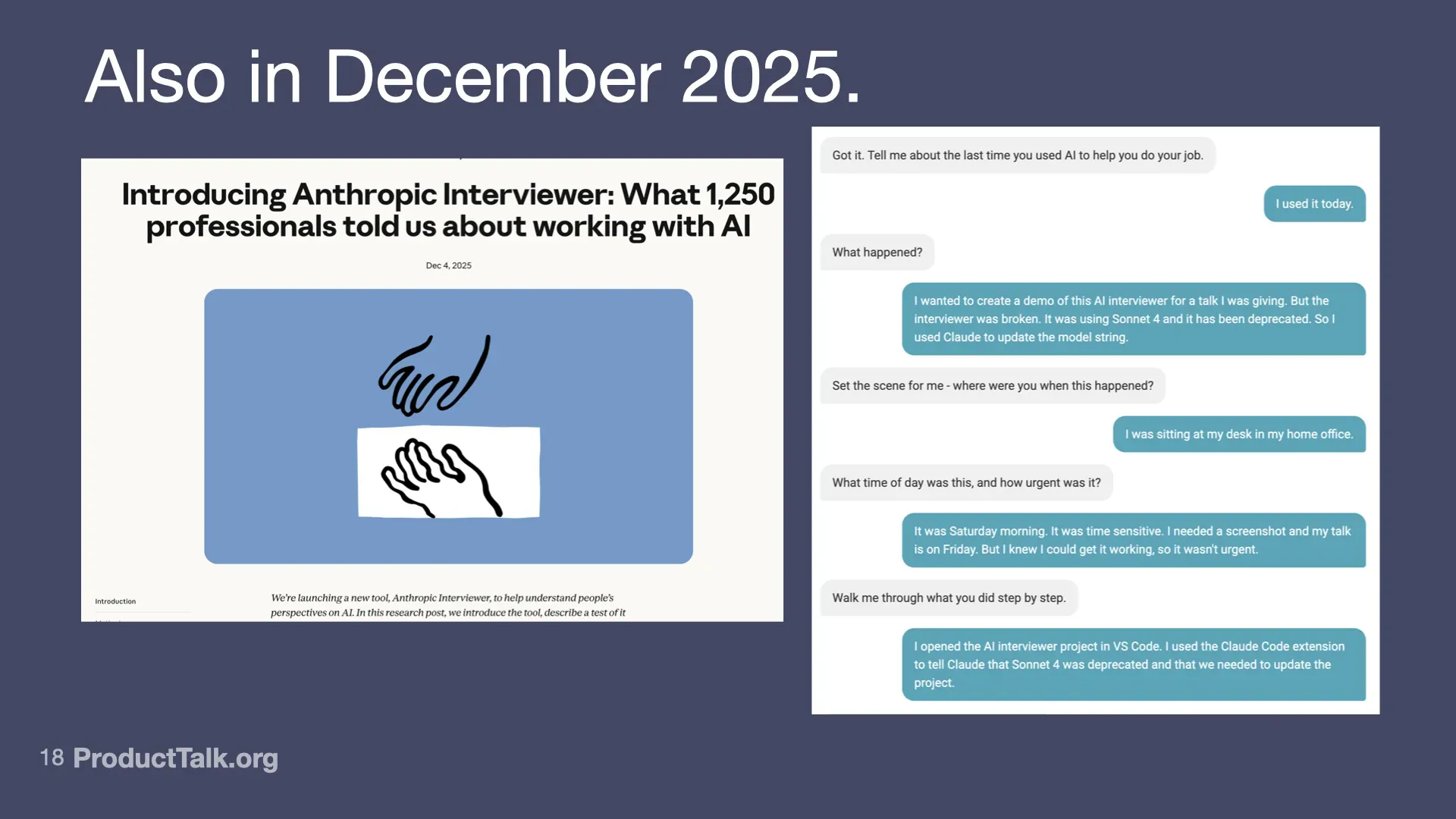
Also in December—some of you might remember this—Anthropic announced they interviewed 1,250 people. The interviewer was Claude.
There were a lot of problems with this. I looked at their transcripts. Very shallow interviews, lots of leading questions. They were trying to learn about AI sentiment. There's a little bit of a selection bias when you use an AI interviewer to learn about AI sentiment.
But I got curious, could I do better? And I started to prototype an AI interviewer. This is something I said I would never do. Because guess what? I want you talking to humans. You the human talking to humans.
But this became a technical challenge for me. Can I do it? And it turns out, I got pretty good at getting an AI agent to collect a story.
This is a prototype. This is not yet a product. And the reason why it's not yet a product—it doesn't feel human. The AI doesn't really know how and when to follow up and where to dig deep. It kind of gets it wrong. But I'm going to keep chipping away at it. It's fun, it's almost like a hobby. Can I do this? Is it possible?
You know what happened when I got curious and started to play with it? I started to see areas that I would want to use it. I don't want to not talk to you. I'm not going to replace my weekly interview with an AI agent, but what if you submit feedback on my website and your feedback's a little bit lazy and it's like, "I didn't like this article." What if my AI agent said, "Tell me more? What did you not like?"
We have all these moments where our customers give us a signal, but they're shallow. Could we use an AI interviewer to make them richer? Not to replace our interviews. Let's be humans talking to humans. But maybe there's a role for AI to be additive. That excited me.
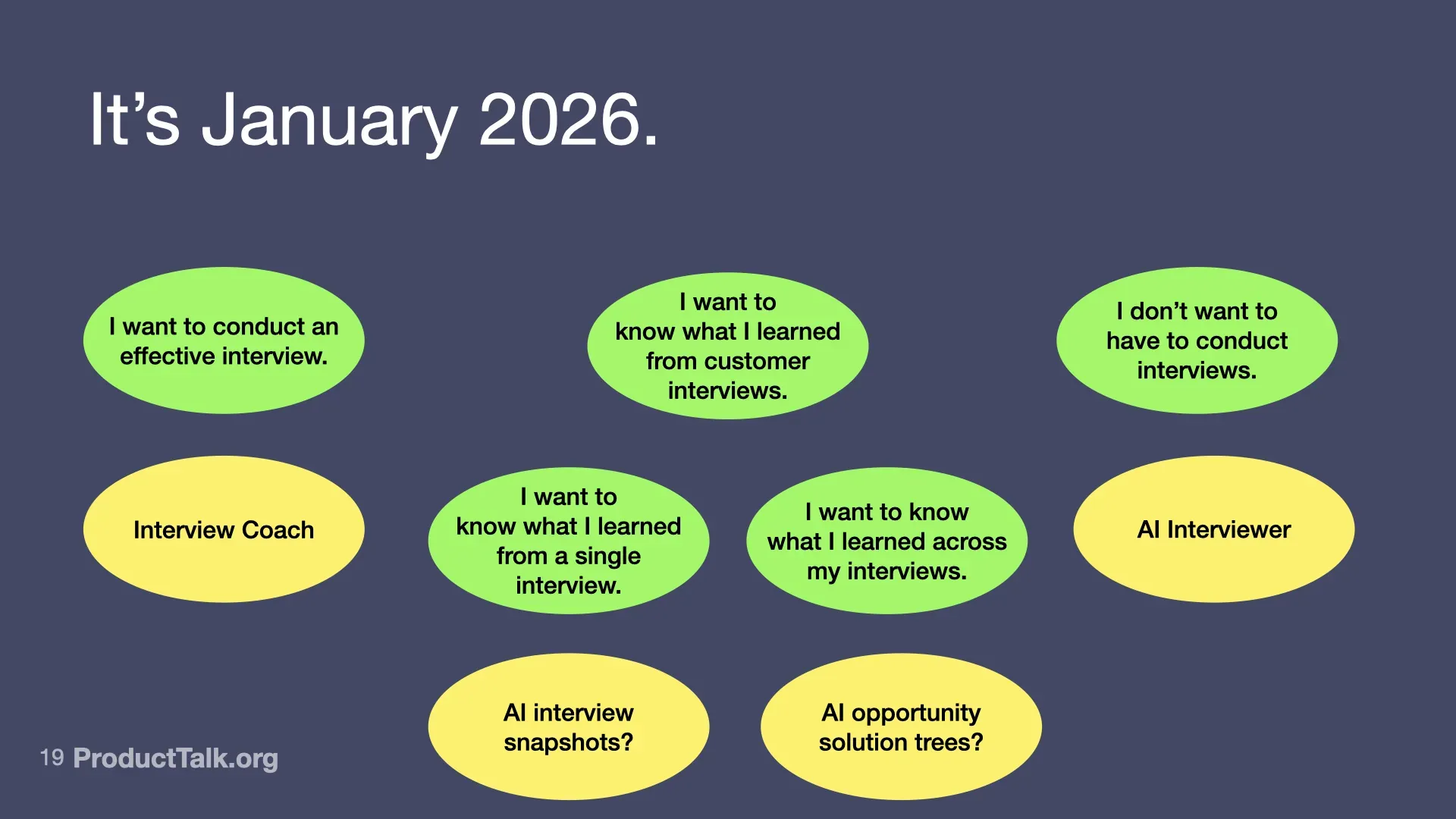
All right, it's now January 2026, just a few months ago. I'm looking at these opportunities, and things look a little bit different.
I've got a couple AI products on the board, starting to get a little swagger about how I can build some AI products. That's cool.
And I look at what's left here, and almost everybody was focused on synthesis. And I hated it because people were just taking their interview transcripts and dumping them in NotebookLM and saying, "It's telling me what I learned." No, it's not. It's telling you really shallow insights.
And what was really missing to me is when I teach synthesis, I don't teach just look at your transcripts. You learn to synthesize a single interview first. This is really critical.
In Continuous Discovery Habits, I introduce you to the interview snapshot. First focus: What did you learn from every individual unique customer? I don't want to lose this. Only then, once you've done that, do you synthesize across your interviews.
I started to get curious, can AI do this? I never thought I would be curious about this. I want humans to do this. But here's the deal: It's really hard for humans to do this. This is a skill that's extremely hard to learn. It takes a lot of practice, it takes a lot of time. I know you don't have time. I've seen your calendars. And I started to wonder, maybe AI can raise the floor.
So I started to think about, could I build AI interview snapshots? Could I build AI opportunity solution trees? Not based on synthetic users, not based on three sentences about your market, based on your real customer interviews, conversations you had with actual humans.
So if I can teach you how to be a more effective interviewer with our Interview Coach, obviously the next step is how do I help you get more value out of that?
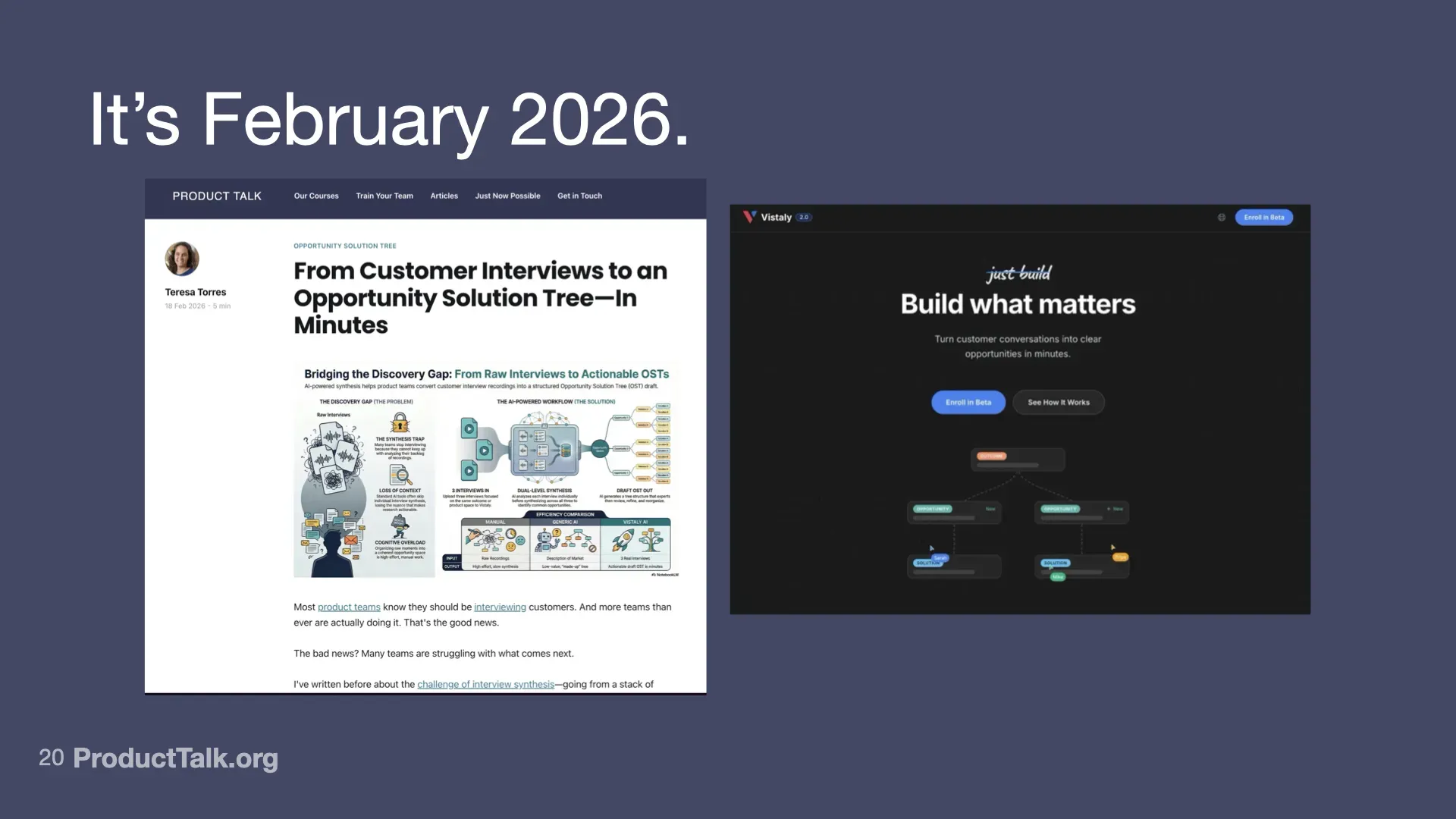
One month later, I'm announcing with Vistaly that we are launching AI-generated interview snapshots and AI-generated opportunity solution trees. Here's the funny thing about this announcement: I'm not an AI engineer. What the hell am I doing? I knew at this point I had built a couple products. I could figure it out.
This is the message I want you to take away from this talk: You can figure it out.
The message is not build AI products. If you want to do that, amazing. Whatever it is you want to do, you now have access to an expert tutor 24/7. You can figure it out. It blew me away.
I have two live products in production. To do this, I had to learn how to be an engineer. I'm not joking. I had never used Git. I had never used IDE. I didn't really know what error handling was. I didn't know what a catch statement was. I had a lot to learn.
I learned it in a very short time because I had an expert tutor. This is the power of this amazing new technology that we have.
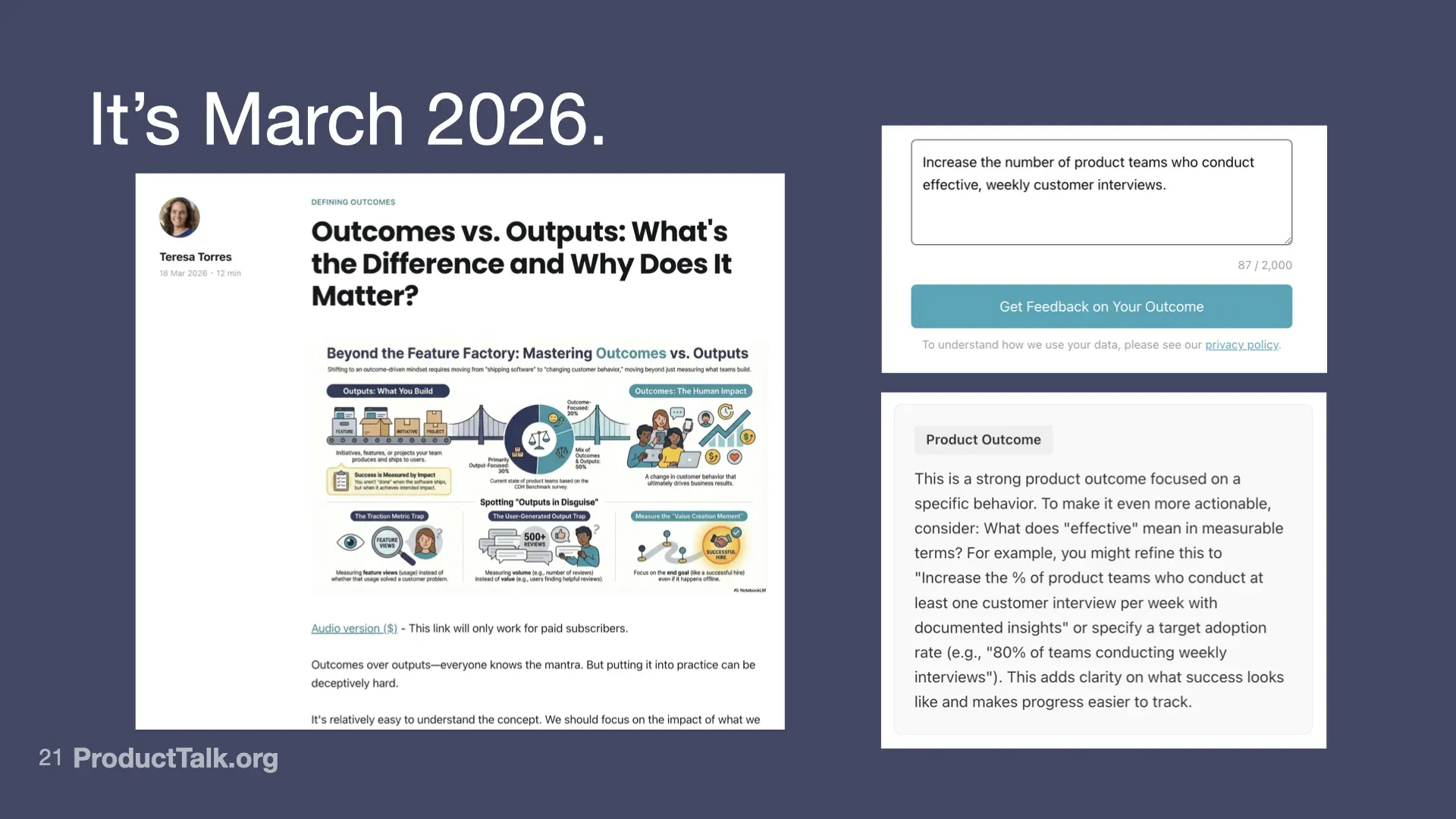
Let's fast-forward again. It's March 2026, just a couple of months ago, one year since I broke my ankle. I'm writing a blog post. It's a topic I've written about 4,000 times. I could not believe I had not already written this blog post. I found this topic through a content audit that Claude did for me on Product Talk. I was like, wow, I've never written about outcomes versus outputs. Maybe I should write that article.
And as I was writing that article, in the back of my head was like, Teresa, the technology exists that you can show people. You don't have to tell people. And so I got curious. Could I build another AI tool? Now, this time not for a course, for a blog post.
I built an Outcome Coach. You can actually try this today. It's live on this blog post. You enter your outcome. You get personalized, detailed feedback. Is it a business outcome? Is it a product outcome? Is it an output? You get a tip on how you can make it better.
I built this in like a day and it's pretty darn good. I tell you I read every single trace because if I'm putting my name on it, it better give you good advice.
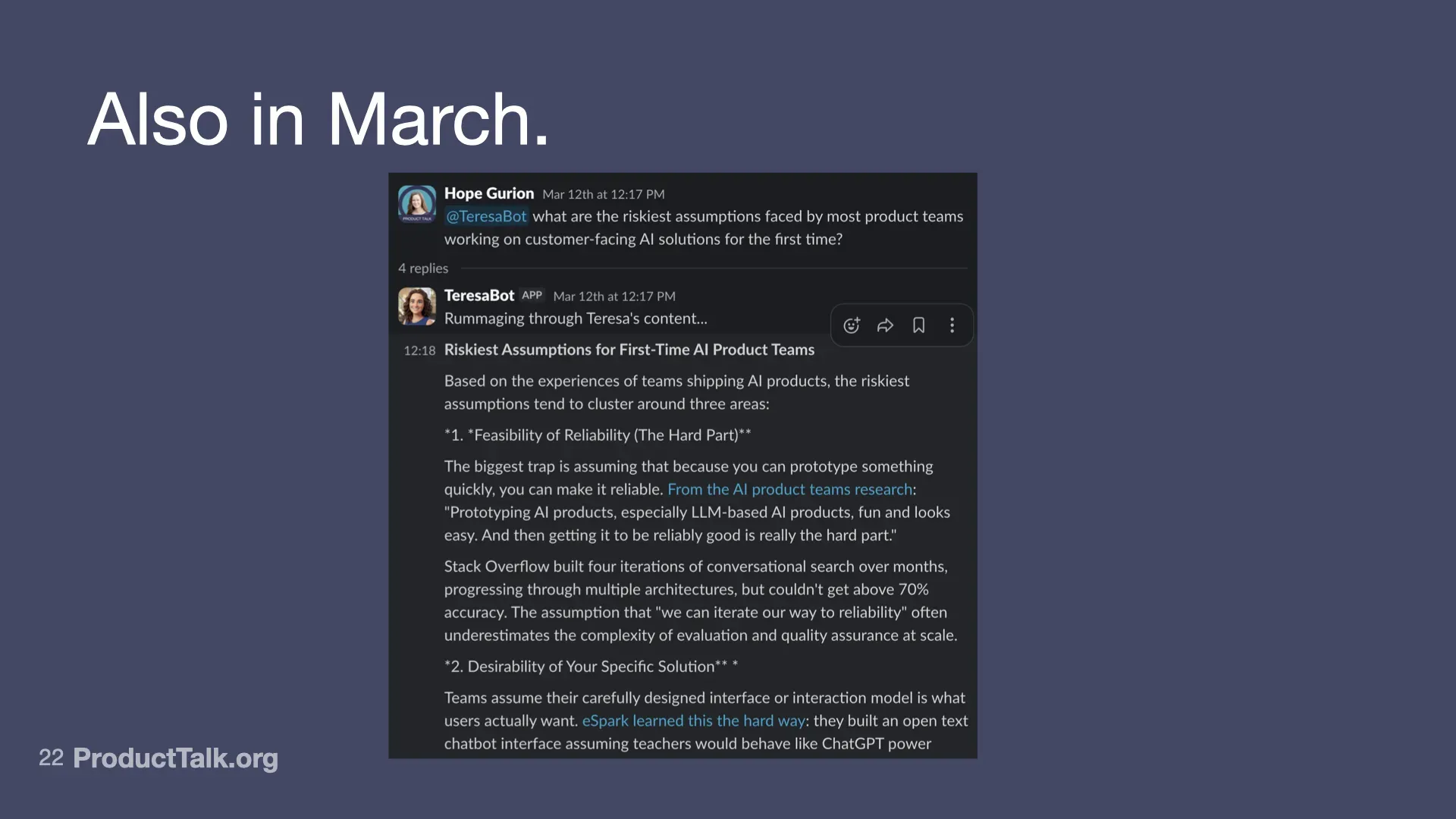
Also in March. There's this company Delphi—they make LennyBot. They offered to give me a year free of their service. I tried it out. There's a reason why I never launched that TeresaBot.
LennyBot is great because when you ask LennyBot a question, it tells you what Lenny's guests said.
My version really drove me nuts because it feels like it's telling you what I said and I look at the responses and I go, "I would never say that." So I'm not putting my name on something that is something I would never say.
But of course I got curious, could I build a TeresaBot that actually tells you what I would say? This exists right now in my CDH Slack community. My community members can ask TeresaBot about almost anything and all it does is it searches all of my content and sends you to an article.
I had never built an embeddings, a vector database. I didn't even know how to do this. I literally asked Claude. We worked through it. I launched it. It's a live product.
On Monday, I was sitting at Heathrow. I was jet-lagged. I had been on a long-haul flight. I was exhausted. I gave TeresaBot new skills. The first skill I gave it was the Outcome Coach. I released it sitting at an airport, deploying production software. I've never done this before.
It's April.
This all sounds rosy, right? Like, Teresa's an AI engineer now.
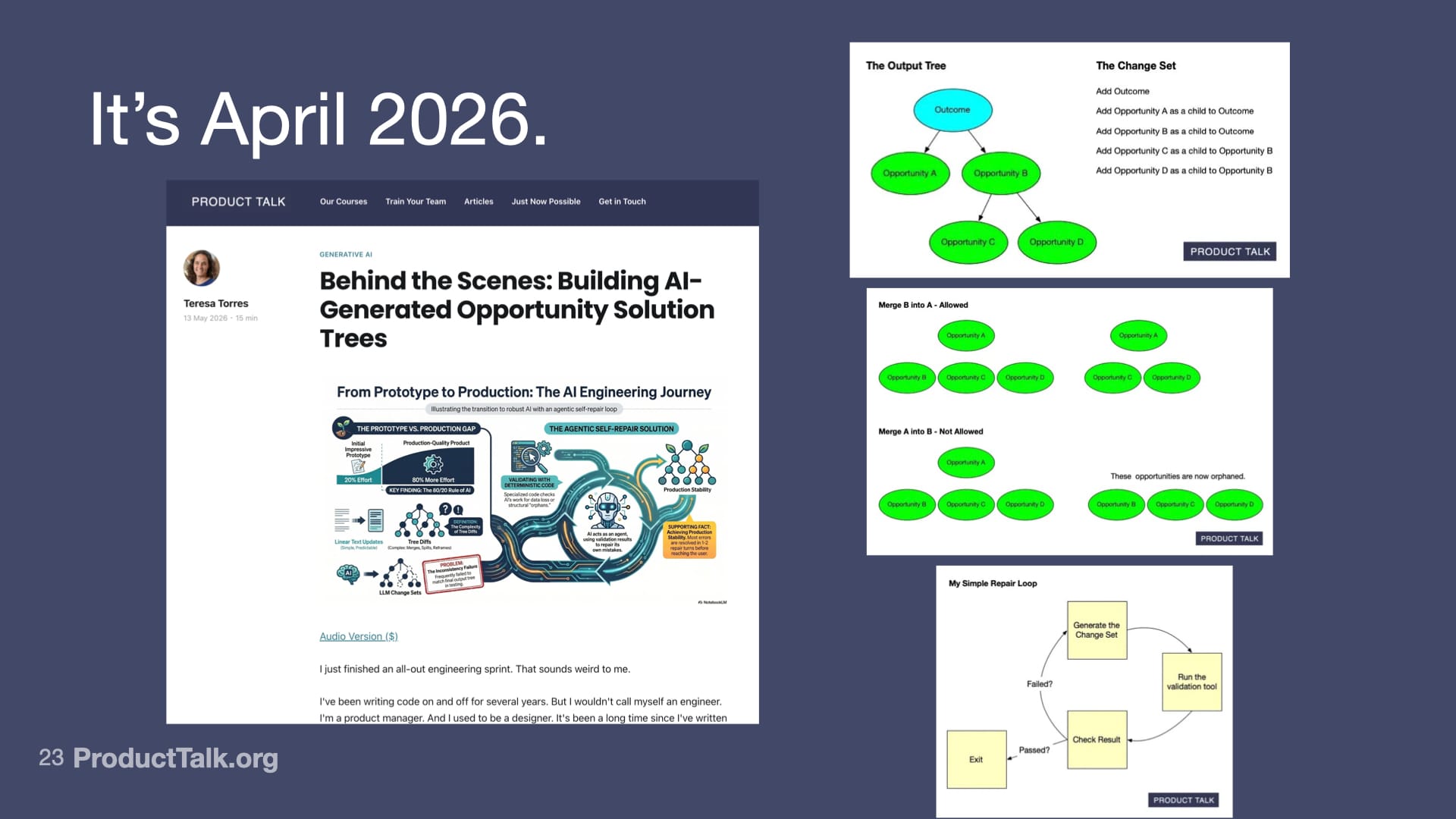
It's a day before Jazz Fest in New Orleans. I'm boarding a plane, and I get an email from Matt at Vistaly. They found a bug. Live production software, real customers. And I said, you know what, Matt? I'm getting on a plane. You can do this short-term fix. I'll look at it when I get back. I enjoyed four days of amazing music. Thank God I had no idea how severe this bug was. Because I come home and I start working on the bug.
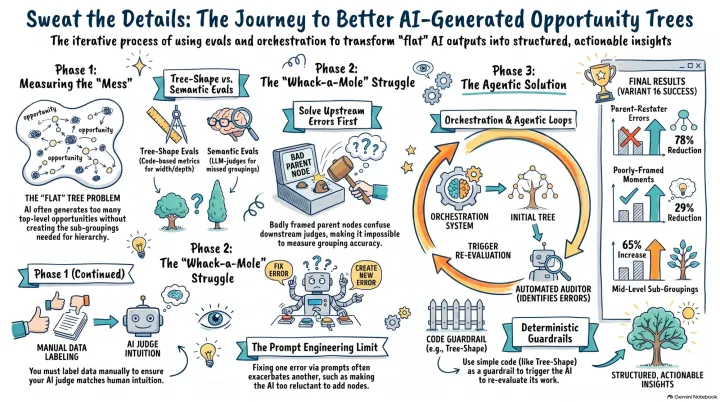
This was a very hard problem. So we're building AI-generated opportunity solution trees, but I don't want AI to do the work for you. I want AI to encourage you to engage with the synthesis.
So we don't just give you an opportunity solution tree. We give you a change set. So the change set walks you through, here's what changed on your tree so that you can collaborate with AI. You can say, I agree with that opportunity. I would frame it differently. I would move this from here to here.
There was a bug in my change sets. This was both an AI bug and a code bug. The AI bug was the AI would generate some impossible moves. The code bug was my code is supposed to verify the AI output, and it wasn't catching it.
I'm not going to say this out of hustle culture. I hate hustle culture. To fix this bug, I spent every waking moment of my life for two weeks in a row—from the moment I woke up to the moment I went to sleep—trying to fix this.
This is one of the hardest engineering problems I've ever tackled. I am not an engineer. That's not true. I am now an engineer.
I had a lot of limiting beliefs about what I could build. After this two weeks, I got a little bit of engineering swagger. I can solve hard problems. This is the best feeling in the world.
Christian asked you, "When was the last time you had fun?"
For me, I shipped a product on Monday. Me, myself, and I. It is amazing. It feels so powerful.
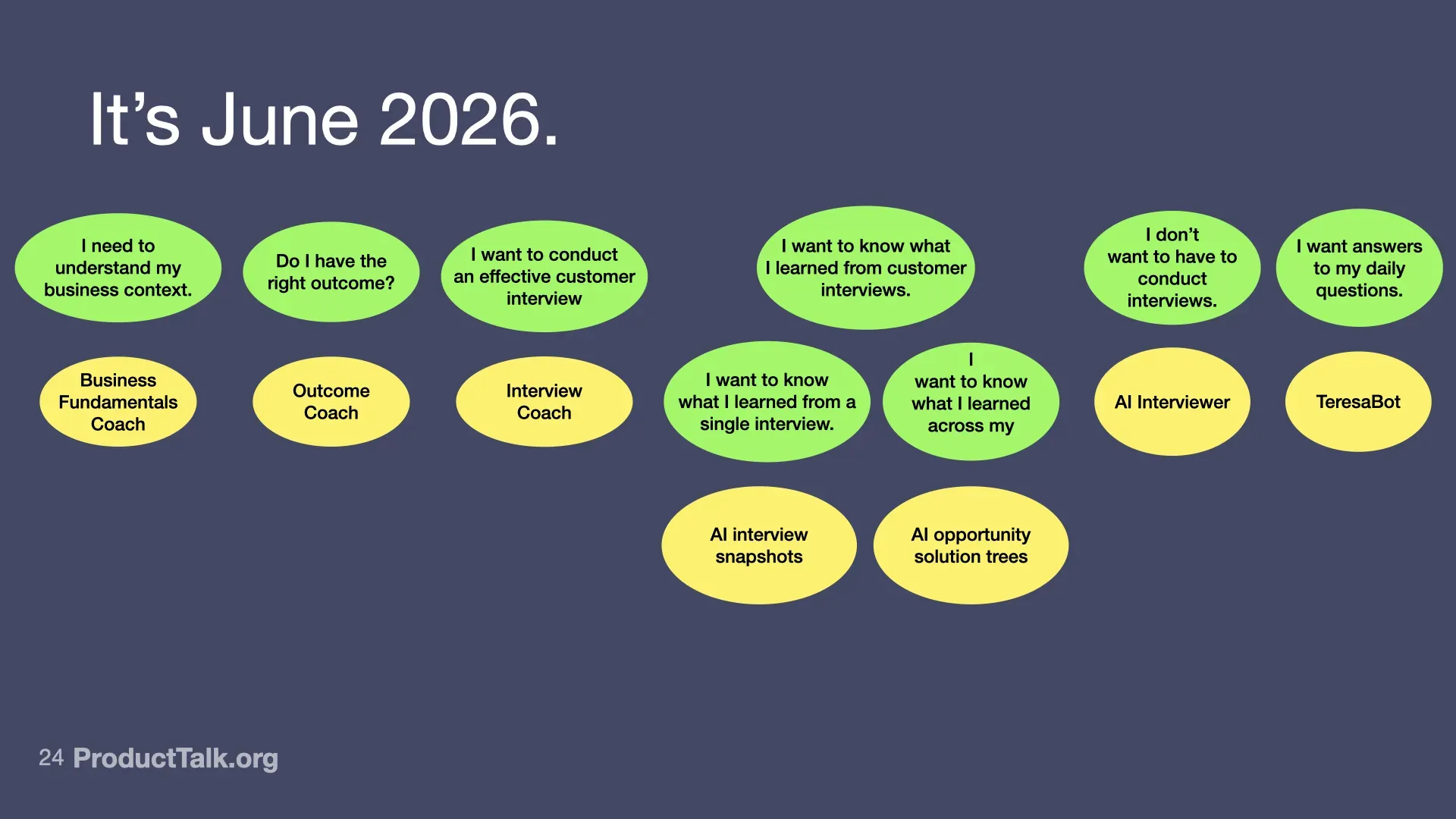
It's June. I'm standing here reflecting on my year with you. Look at this map. I have so many AI products. I don't know how to do this. I'm figuring it out.
Okay, I'm not telling you to build AI products. I'm not telling you to become an engineer. When I look at this past year, you want to know what I see? I see a narrative that humans have been talking about for centuries. Can anybody see what it is?
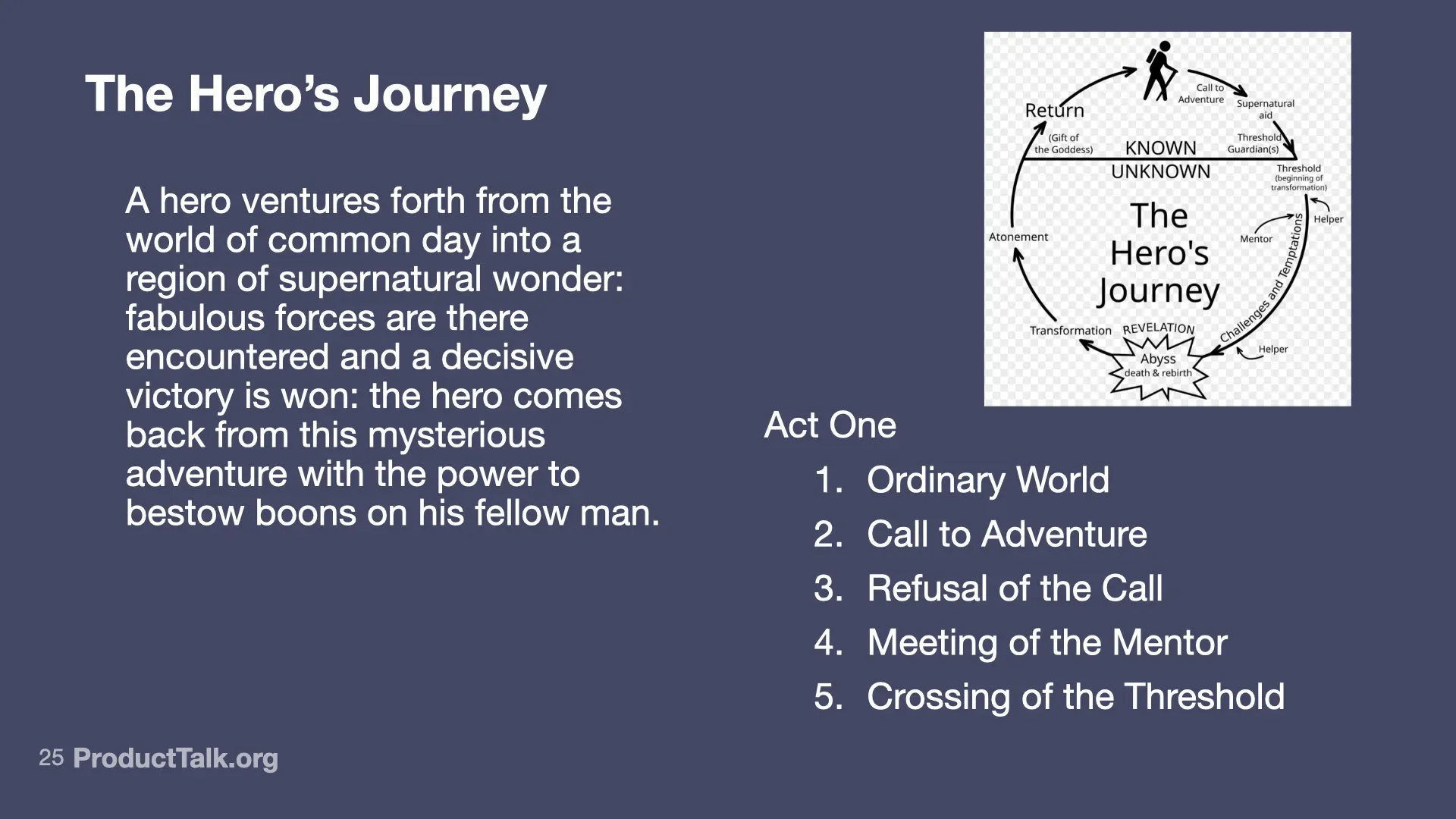
I'm not saying I'm a hero. That's not what this says. The hero's journey is a story humans have been telling for centuries because it's how we learn and grow.
Here's what act one of the hero's journey is: The hero, the protagonist, is living in their ordinary world. They get a call to adventure. They resist the call. Something changes. They take their first step. They meet a mentor. They get help along the way as they cross into the threshold of the new world.
I looked at this and was like, this was my year. I didn't want to do any of this! I want you to talk to humans. What do I want to use AI for in discovery? But this has opened up so much possibility.
I do still have courses. You're welcome to take them.
I am no longer designing courses to teach discovery. I am creating software to teach discovery. My medium has changed.
It has been the most fun I've had in my entire career. The last year—the most fun I've ever had in my entire career.
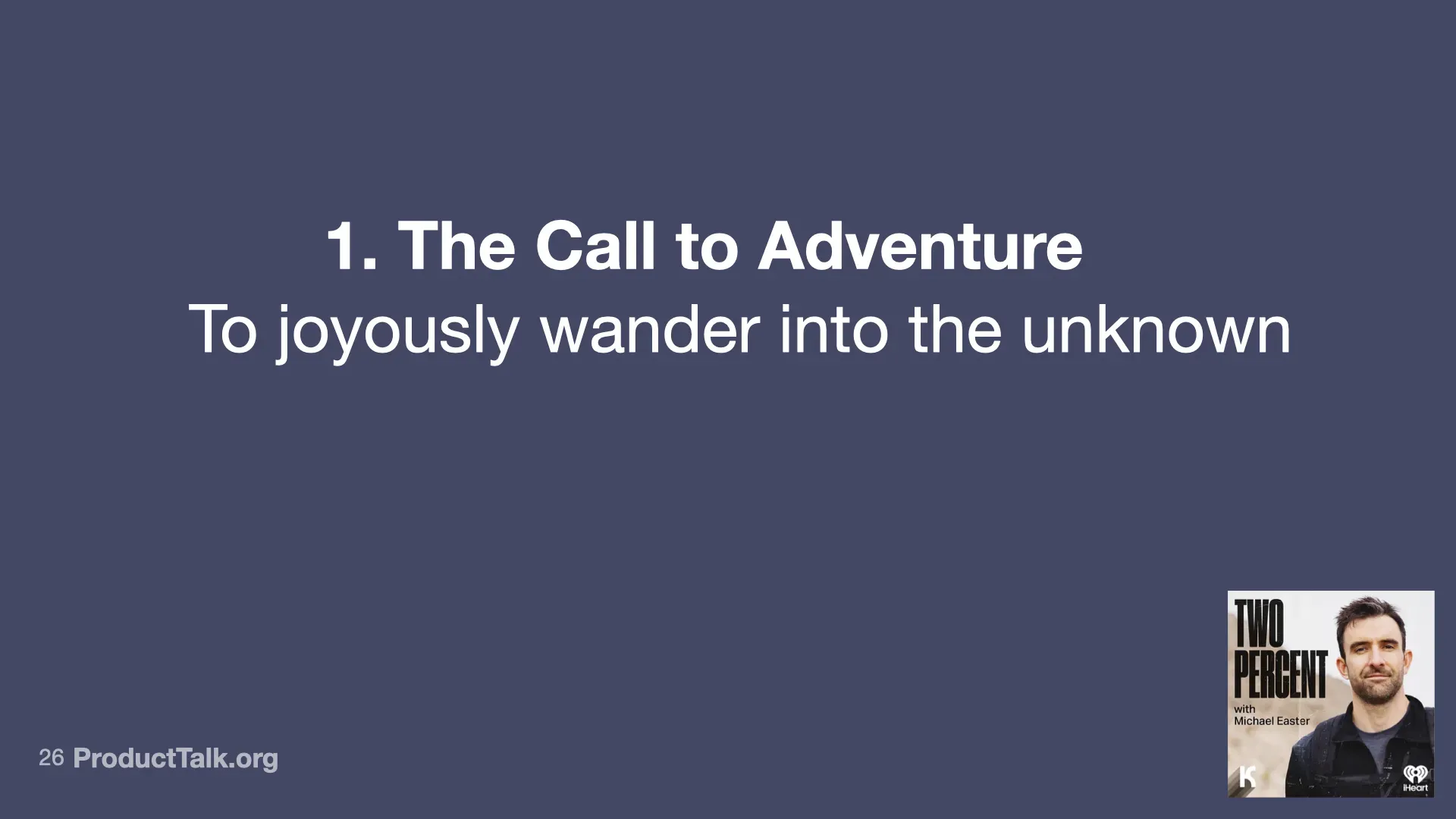
The reason why I'm telling you my story is not to convince you to be an engineer, not to convince you to build with AI.
Every single one of us are facing change. That's the theme of our conference today. Everything around us is changing. New jobs are being created. Jobs are going away. Our roles are changing. Our product trios are collapsing.
We're being asked to do all sorts of new things. We are all being called to adventure. Every single one of us. All I did was I heeded the call. I took the first step. The first step led to the next step. That step led to the next step. I took lots of teeny-tiny steps. None of them were that scary—except for the first one.
I was listening to a podcast last week and it gave me goosebumps because it was perfect for this talk. The host, Michael Easter, he has the Two Percent podcast, some of you might know it. He was interviewing his guest and he said, "How do you define adventure?" And he said, "To joyously wander into the unknown."
This is what I've been doing for the last 15 months. It has been an absolute delight. I have no idea where I'm going. I have no idea where this story ends. But I am having more fun than I've ever had.
Michael Easter is awesome. I strongly recommend you check out his podcast if you're into fitness or self-improvement.
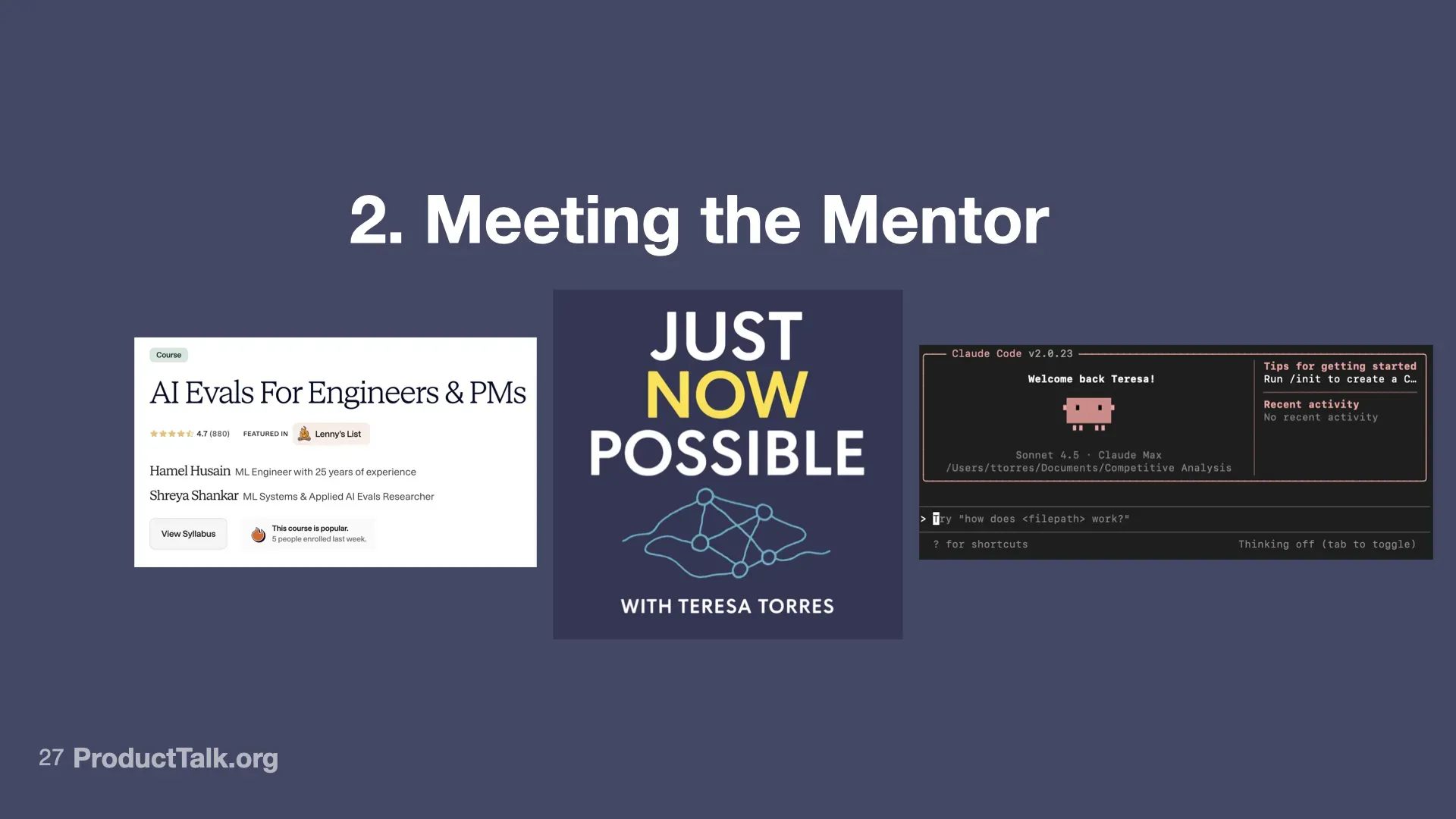
The second thing I want to highlight in the hero's journey is that I'm not doing this alone. A really important part of Act 1 is the mentors you find. I've had a lot of really great mentors.
I landed on Shreya and Hamel's course. It really accelerated my learning. I created my own mentors by launching a podcast. I'm sharing those stories with you so you can come on this learning journey with me.
And I can't lie, Claude is the best mentor. So is OpenAI. So is your favorite open source model, right? We have expert tutors 24/7. This is amazing.
The other thing I'm going to tell you, and this is the one where fear comes in—we feel like we're doing something wrong, we feel like it's risky. A really important part of Act 2 in the hero's journey is trials and tribulations, finding allies, meeting enemies, overcoming.
But the reason why this is hard is we expect it to be easy. We're not good at being beginners. We're good at being mid-career professionals that are pretty good at what we do. I know, that's how I felt, right?
We should not expect it to be easy. The challenge is what makes it rewarding. I told you about my two weeks working on that hard bug. It was the hardest thing I have ever done in my entire life.
I started talking to other engineers about it, and they were like, "Teresa, change sets are a legitimately hard problem." And I was like, "Oh, I didn't know. I just said I would do it," right? It was also the most fun I've ever had in my career, ever. Highlight, underline, ever.
So here's what I'm here to tell you today. We are all being called to adventure. Your adventure might look different from mine. That's okay. I want to ask you, how will you answer the call?
When you meet me out in the hallway, tell me. I want to hear about it. What are you doing? How are you taking advantage of all this change? This is an opportunity to reinvent ourselves and to have more fun than we've ever had.
Don't ignore that. Embrace it.
Thank you, everybody.
Comments ()