
Customer Interviews: How to Recruit, What to Ask, and How to Synthesize What You Learn

A customer interview is a conversation with a customer or user with the intent to learn more about your customer or user’s goals, needs, and context.
Customer interviewing is one of the most valuable activities a product team can do. It’s simply the easiest, most sustainable way of learning about your customers and what they need. This knowledge gives teams a competitive advantage that compounds over time.
Whether you are brand new to conducting customer interviews or have conducted hundreds of customer interviews, this guide will cover everything you need to know.
There are three ways you can use this guide:
- Read it straight through from start to finish. This is a great strategy if you are looking for a deep tutorial on customer interviews.
- Use the Table of Contents below to jump around to answer your most pressing questions. This is a great strategy for people who are already conducting customer interviews and need targeted help.
- Subscribe to our continuous interviewing email course using the below form. It breaks the guide content into bite-sized pieces and delivers one to your inbox each day. This is a great strategy if you want to develop your customer interviewing knowledge over time.
Table of Contents
- What doesn’t count as a customer interview?
- Customer interviews vs. user interviews: Is there a difference?
- Who should you interview?
- Who should conduct customer interviews?
- What is continuous interviewing? Or how often should you conduct customer interviews?
- Should you talk to the same customers over and over again or always a different customer?
- How do you find customers to interview every week?
- Do you need to give customers an incentive to participate in customer interviews?
- How do you recruit for customer interviews without an incentive?
- What if my sales or account management team won’t let us interview customers?
- What do you ask and not ask in your customer interviews?
- How do you collect a specific story?
- What does a story-based customer interview look like?
- How do you synthesize what you learn from each customer interview?
- Can you use AI to analyze customer interviews?
- How do you communicate with your stakeholders what you are learning from each customer interview?
- How do you synthesize what you are learning across your customer interviews?
What doesn’t count as a customer interview?
Not all engagements with customers are customer interviews. For the purposes of this article, the following activities are not customer interviews:
- Usability tests or prototype tests or any other customer conversation about potential solutions.
- Sales conversations where the intent is to close a sale or renew business.
- Support conversations where the intent is to resolve a customer complaint.
These activities can be quite valuable and have a place in our toolbox. But I believe they are fundamentally different from a customer interview where the primary intent is to learn about our customers’ or users’ goals, needs, and context.
Further reading:
Customer interviews vs. user interviews: Is there a difference?
"User" is typically used to refer to someone who uses a product or service. "Customer" is often used to refer to someone who buys a product. With consumer products, a person is often both the customer and the user. In business software, the customer and the user are often different.
However, for our purposes, you can think of customer interviews and user interviews synonymously. The activity and techniques are the same.
Who should you interview?
The goal of a customer interview is to learn about your target prospect, customer, or user. Who you’ll want to interview will depend on your product.
If you work on a subscription product (e.g. Apple Fitness+, Netflix, Dropbox) and your team is responsible for retention, you probably want to talk with both engaged and unengaged customers (e.g. people who are currently subscribed to your product). You might also want to talk with customers who recently canceled their subscription.
If you work on a B2B product, you have both customers and users. If your company is small and your team works on satisfying both customers and users, then you’ll need to interview both. As companies grow, they tend to have teams focus on one vs. the other, in which case, each team would interview their own target customer.
If you work on a B2B2C product, then you might have business customers, business users, and consumers. You might need to interview all of these folks, but as your company grows, your team will likely focus on just one of these audiences, while other teams focus on the others.
If you work on a two-sided marketplace, then you might need to talk to buyers and sellers. But again, as your company grows, your team will likely focus on one vs. the other.
If you work at an early-stage startup and you don’t have any customers yet, then you need to talk to prospects. If you don’t have any prospects, then you need to interview people who match your ideal customer profile.
(Learn more about how continuous discovery works in early-stage startups here.)
If you work on software that your internal colleagues use (e.g. call center software used by internal customer representatives or inventory systems used by your colleagues), then your customers are your colleagues who use that software.
If you work on a platform team building services for other teams, then your customers are those other teams.
And so on. The goal is for your team to talk to the people who are using your software. Your goal in a customer interview is to learn about their goals, needs, and context so that you can design better solutions for them.
Further reading:
- Ask Teresa: How Do You Select Customers for Customer Interviews?
- How Continuous Discovery Works (And Doesn’t) in Early-Stage Startups
Who should conduct customer interviews?
I prefer to see the product trio (a product manager, a designer, and a software engineer) interview customers together. Discovery is a team sport and it’s easier to align as a team when we are talking to customers together.
That doesn’t mean all three people are peppering the customer with questions. One person can conduct the interview, but the other two roles should watch and synthesize the interview.
And be careful that you don’t over rely on the same person to conduct each interview. All three roles should be proficient at interviewing. When everyone on the team can conduct an interview, the team builds a more robust habit of interviewing regularly.
Further reading:
What is continuous interviewing? Or how often should you conduct customer interviews?
For most product teams, I recommend you interview at least one customer every week. If this cadence sounds overwhelming, consider this a benchmark to aspire to. You can get there iteratively over time. Try to talk to a customer every month, then every few weeks, then every other week, until eventually you get to every week.
The habit is more important than the number of people you talk to. I’d rather you talk to one customer every week than four customers one week and no customers the next week.
Turning this behavior into a habit makes it sustainable. It’s easier to maintain a habit than it is to start and stop an activity.
Also, product teams make decisions every day. To make good product decisions, we need to have a current understanding of our customers’ goals, needs, and context. These factors are fluid. The longer we go without talking to a customer, the more likely our understanding of these factors will be out of date.
Further reading:
- 3 Best Practices for Adopting Continuous Product Discovery
- This Keystone Habit Will Fuel the Rest of Your Continuous Discovery Habits
- Product in Practice: Making Customer Interviewing a Habit in an Early-Stage Startup
Should you talk to the same customer over and over again or always different customers?
When you are new to interviewing, I recommend talking to a wide variety of people. Our goal with qualitative research is to uncover the variation in our customers’ experience. The more people we talk to, the more variation we uncover.
However, when we talk to the same customer over time, we learn about a depth of experience that we simply can’t get from a single conversation. We also learn how a customer’s goals, needs, and context change over time.
I recommend you first build your weekly habit of interviewing different customers each week. Once that’s a stable habit, then I’d look at identifying a few different customers who are interested in engaging with you over time and mix this in.
Further reading:
- Ask Teresa: How Do You Select Customers for Customer Interviews?
- Why You Are Probably Interviewing the Wrong People and How to Fix It
How do you find customers to interview every week?
I recommend teams automate their recruiting process. This might sound magical, but the goal is for you to start each week with an interview already on your calendar without you having to do anything to get it there. This makes it easier for you to interview than to not interview.
In my book, Continuous Discovery Habits, I recommend three common strategies for automating your recruiting process:
- Recruit participants while they are using your product or service.
- Use your customer-facing teams to help you recruit.
- Set up a customer advisory board or customer community where you can recruit individual interview participants.
I cover all of these strategies and much more in our Customer Recruiting for Continuous Discovery course.
 Teresa Torres
Further reading:
- Customer Recruiting: Get Easy Access to Customers Week Over Week
- Product in Practice: Automating Customer Interview Recruiting at Zonar Systems
- Tools of the Trade: Finding People to Interview Before You Have Customers
Do you need to give customers an incentive to participate in customer interviews?

It depends. I recommend you try recruiting without an incentive and only use one if it’s needed. If an incentive is needed, most teams assume they need to provide a cash incentive, but I find this is not an effective incentive in most contexts.
In B2C contexts, you can almost always spend less money on an incentive with more perceived value than cash. Try to find something that is complementary to your product or service. For example, if you work on a consumer note-taking app like Notion, you might give away a customized paper journal. It might only cost your company $10–15 to print each journal, but odds are your customers will value the journal more than the equivalent cash because it’s not something they can simply go out and buy. Or you can offer a free trial or a discount on service as an incentive. For example, most Netflix customers might value three free months of service more than the actual cash value of this offer.
For B2B contexts, many companies have rules that restrict employees from accepting gifts from vendors. Interview incentives can often be considered gifts. This means that the incentives you offer in a B2C context likely won’t work in a B2B context. Instead, consider incentives that help the employee do their job better. For example, you might offer an invitation to an exclusive “how-to” webinar that they otherwise might not get access to. You can also offer discounts on your services here as well.
How do you recruit for customer interviews without an incentive?
It’s all about how you position the ask. There are several reasons why people don’t accept interview requests:
- They don’t have a lot of free time.
- They don’t know what’s in it for them.
- They aren’t sure what to expect from the interview. Most people will resist simply due to a fear of the unknown.
When we ask people for an hour of their time to help us by participating in our research, we don’t tackle any of these concerns. An hour is a lot of time. Most people don’t know what to expect from a research session, and it sounds like we are asking for a favor. This is an easy no. And yet, I see most teams recruit this way.
Instead, ask for a small amount of time, clearly state the benefit for the customer, and explain exactly how you’ll use your time.
For example:
- Do you have 20 minutes to share a quick story about how you set this quarter’s goals? In exchange, we can help you optimize your process with industry best practices.
- Do you have 20 minutes to share how you chose the TV show you are watching? We’d be happy to share similar shows that you also might like.
What if my sales or account management team won’t let us interview customers?
Start small. If you need to, leverage your personal network to have an initial conversation with someone who is like your customers. For example, if you work on electronic medical records, do you have a doctor or nurse in your personal network that you could talk to? If you work in banking, can you talk with any of your friends with bank accounts about their money habits?
Once you’ve had an initial conversation, befriend one sales rep or account manager. Share with them what you learned from your own contact and how you plan to act on it. Ask them if they have a customer with a similar need. See if they are open to having you talk to them as well. Iterate from there.
Don’t start by fighting the ideological war of who should get to talk to customers. Just find a way to make incremental progress. Iterate from there.
Further reading:
What do you ask and not ask in your customer interviews?
Ask the participant to tell you a story about their specific past behavior. Start with a question like, "Tell me about the last time you ..." You can end that ask with:
- used our product or service (e.g. Tell me about the last time you used Netflix.)
- used the product category your product or service belongs to (e.g. Tell me about the last time you watched TV.)
- experienced the problem your product was designed to solve (e.g. Tell me about the last time you entertained yourself in the evening.)
The key to a good customer interview is to keep the interview participant grounded in specific stories about their past behavior. Why does this matter?
It turns out, us humans—all of us—are susceptible to a wide variety of cognitive biases. Basically, we make silly mental errors from time to time. These biases can interfere with our ability to collect reliable feedback in our interviews.
Most of us think we are above-average listeners and/or drivers. Stop and think about that. We can’t all be above average.
If you work out, you probably overestimate how often you work out. Or if you identify as a healthy eater, you probably overestimate how healthy your diet is. Why? Because we tend to define ourselves aspirationally. We aspire to work out more or to eat healthier. We might even do so some of the time.
But when we are asked questions about our general behavior, we tend to overestimate. That’s because we forget about exceptions. We forget about the friend’s birthday party where we had cake. We forget about that day last week when we skipped the gym for an important meeting. It’s not just you—we all do this.
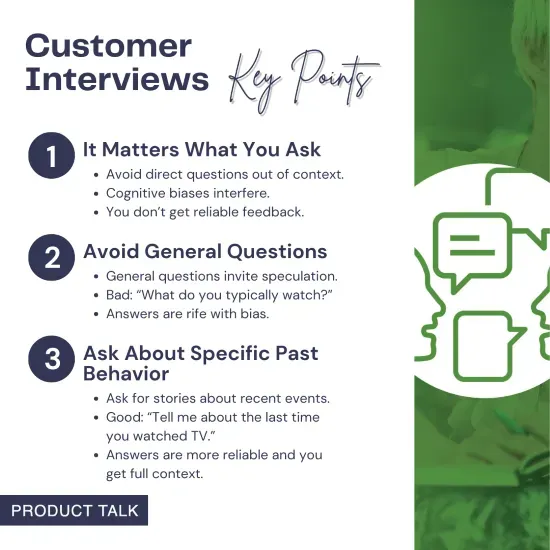
The problem when it comes to customer interviews is we don’t want to build our products based on what people aspire to do. We want to build our products based on what people actually do.
To uncover what people actually do, we need to collect specific stories about past behavior. We need to ask, “Tell me about the last time you watched streaming entertainment.” Not, “What do you typically watch?”
When we ask for specific stories (as long as they are memorable), we get reports of actual behavior. When we ask what people generally do or usually do, this is when cognitive biases interfere.
Further reading:
- Story-Based Customer Interviews Uncover Much-Needed Context
- Ask Teresa: What Are the Best Customer Interview Questions?
- Why You Are Asking the Wrong Customer Interview Questions
- Ask About the Past Rather than the Future
How do you collect a specific story?
Collecting specific stories is a skill that will take time to develop. It takes practice.
If I prompt you by saying, “Tell me about the last time you watched streaming entertainment,” you are likely to answer, “It was last night after dinner.”
That’s not a very compelling story.
As the interviewer, you need to work to excavate the story. You need to help the participant remember and tell their story.
Our Interview Coach can give you personalized, detailed feedback as you practice. Get access through the Story-Based Customer Interviews course.
 Teresa Torres
Further reading:
- Story-Based Customer Interviews Uncover Much-Needed Context
- The Ladder of Evidence. Get More Value From Your Customer Interviews and Product Experiments
- How to Develop Your Active Listening Skills
- How to Take Notes During Customer Research Interviews
What does a story-based customer interview look like?
I share three examples of short interviews in this article: Story-Based Customer Interviews Uncover Much-Needed Context
The first interview shows what you should not do in your interviews. The second interview is a quick story about a specific past behavior. The third interview is an even richer story of a past behavior.
If you are interested in more examples, our Interview Vault (available through our Story-Based Customer Interviews course) includes 15 real, full-length customer interviews (5 AnyList customer interviews and 10 Lovable customer interviews).
How do you synthesize what you learn from each customer interview?
Our goal in each customer interview is to collect at least one story about specific past behavior. As we collect stories, unmet needs, pain points, and desires—also known as opportunities—emerge. These opportunities are what make interviews actionable.
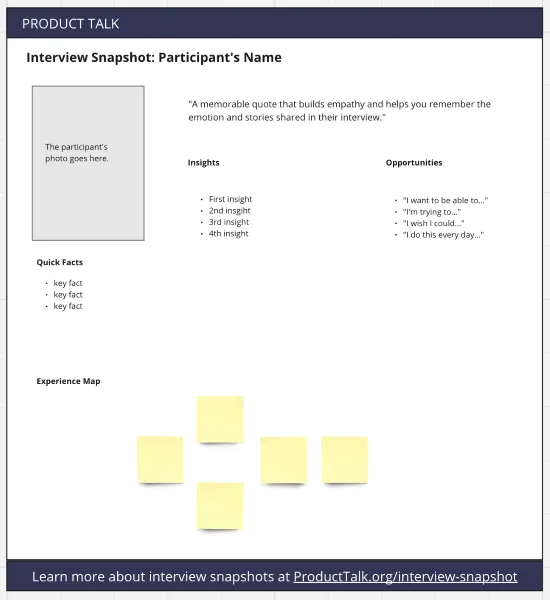
To synthesize what I learn from a single interview, I like to create an interview snapshot. An interview snapshot is a one-page overview of what I heard in an interview. It includes the following components:
- A photo of the participant
- A memorable quote that represents the story that was told
- Some quick facts about the customer so I know how to put the story into context
- An experience map that depicts the story
- A list of opportunities that emerged from the story
- And a list of any other insights that I want to capture from the interview
The goal is not to capture every word that the participant said. We can transcribe interviews if we need a record of every word. Instead, the goal is to find the key moments in the story where opportunities emerged. This tells us how we can help this customer.
Learn more about interview snapshots: The Interview Snapshot: How to Synthesize and Share What You Learned from a Single Customer Interview
With continuous interviewing, we interview customers every week. If we build the habit of creating an interview snapshot for every interview, we’ll collect a robust set of customer stories over time. Looking for patterns across these stories and finding common opportunities across unique stories is what helps us create value for many customers at once.
Can you use AI to analyze customer interviews?
Yes, absolutely.
However, AI out of the box isn't going to do a great job. The agent will need to know your context, what you are trying to learn from your interviews, and how you want it to go about the analysis.
There are many ways to synthesize the same interview. So you'll need to direct the agent. If you are interested in AI synthesis that is designed to help you find key moments and opportunities in story-based customer interviews, check out my work with Vistaly. We are building AI-generated interview snapshots.
For more on this topic, check out: Customer Interview Analysis: Where AI Helps and Hurts
How do you communicate with your stakeholders what you are learning from each customer interview?
Many teams share videos of their interviews and/or pages and pages of interview notes with their stakeholders. But these strategies assume that our stakeholders have time to dive deep into each interview. They often don’t. That’s our job.
However, when we synthesize what we are learning down to a research deck with a summary of findings, we often lose critical context. We tend to generalize across our customers, instead of remembering that each of our customers is a unique person with their own story.
Instead of relying on these older methods to communicate with stakeholders, I like to share interview snapshots with my stakeholders. The experience map helps them visualize the story. The opportunities help them see how we might put what we learned into action. And the memorable quote helps them build empathy for our customers.
It’s a great way to communicate quickly and often.
Further reading:
- Stakeholder Management for Product Teams: Show Your Work, Don't Sell Your Conclusions
- Show Your Work: How to Justify Your Decisions and Get Stakeholder Buy-In
How do you synthesize what you are learning across your customer interviews?
Synthesis happens in two steps. First, we analyze what we learned in each interview with interview snapshots. Then once we have three to four interviews, we are ready to start synthesizing across our interviews.
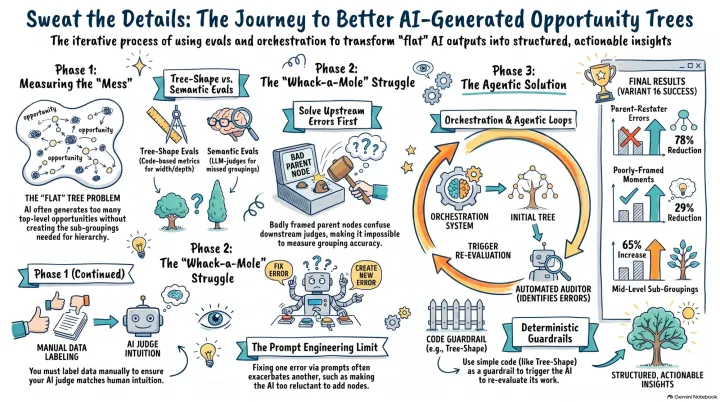
I developed opportunity solution trees to help us do exactly this. You can learn more about opportunity solution trees in our in-depth guide: Opportunity Solution Trees: Visualize Your Discovery to Stay Aligned and Drive Outcomes
What did we miss? What other questions do you have about customer interviews? Let us know on Twitter (@ttorres), Mastodon (@index@producttalk.org) or LinkedIn.
Comments ()